
01 · Answer first
Your donor area is the limit no technique can remove
The donor area is the hair-bearing scalp from which follicles are surgically taken, usually a carefully selected band across the back and sides. Its size, density, stability and hair quality set the ceiling on what transplantation can achieve. Surgery redistributes existing follicles; it does not manufacture new ones. 12
This makes donor assessment more important than a fashionable technique or headline graft number. A broad recipient area can demand more hair than the donor can safely spare. The central planning problem is therefore not ‘How many grafts can we take today?’ but ‘How many can be used over a lifetime while the donor still looks acceptable?’
Hair transplantation is usually private cosmetic surgery in the UK, though professional bodies describe pattern loss as a genuine medical condition. The NHS advises checking the operating doctor and regulator before proceeding. 12
02 · The source
Why the back and sides are used
Androgenetic alopecia affects follicles according to their inherited sensitivity to androgens. Suitable occipital and parietal follicles tend to resist the progressive miniaturisation seen across the front, mid-scalp and crown. When moved, they generally retain important donor characteristics—a principle called donor dominance. 7
The donor is not one uniform rectangle. Density, shaft diameter, curl and the proportion of single- and multi-hair follicular units vary from nape to mid-occiput and towards the ears. Fine marginal hair may be useful aesthetically but can also sit outside the most stable long-term boundary.
Modern surgery transfers follicular units: small natural groups containing one or more hairs and supporting structures. Each removed unit permanently reduces density at its original site. The art is to distribute that reduction so surrounding hair and hairstyle continue to provide coverage.
- Occipital: central back of the scalp
- Parietal: stable areas towards the sides
- Nape and around the ears: often finer and potentially less stable
- Margins: require caution, especially in young or advanced loss
03 · Probability
‘Safe’ is a map of probability, not a lifetime guarantee
The classic safe donor area was developed from observations of older men with different degrees of pattern baldness. Unger and colleagues studied 328 patients aged 65 or over and mapped areas retaining a minimum hair presence even in advanced patterns. That work remains influential because it looked backwards from later-life loss. 13
Its boundary is a population-derived guide, not a personalised forecast. Head shape, family pattern and progression differ. Later research has proposed proportional measurements and anatomical landmarks, but these are not universal standards across all populations.
A surgeon should narrow or adapt the zone when examination shows miniaturisation, an unusually high crown drop, retrograde thinning near the neck or thinning around the ears. Conservative boundaries sacrifice some theoretical supply to reduce the chance of moving hair that later disappears.
04 · Uncertainty
Why today's donor appearance may not predict the next 30 years
Pattern hair loss is progressive and no test can state exactly where an individual's final boundary will settle. This uncertainty is greatest in younger adults whose current loss has not revealed the mature pattern. Aggressive extraction at 22 may sit above or below stable hair when that person is 50.
Diffuse thinning demands particular care. In diffuse unpatterned alopecia, miniaturisation extends through the supposed donor zone, undermining the biological basis of transplantation. The label and suggested diagnostic thresholds are not perfectly standardised, but obvious donor involvement is a reason for dermatological investigation rather than immediate surgery. 15
Inflammatory or scarring scalp disease can also affect growth and healing. Sudden shedding, itch, scale, redness, pain or patchy loss requires diagnosis. A transplant should not be used to conceal an active process that could destroy native and transplanted follicles.
- Age and speed of progression
- Family pattern of advanced loss
- Miniaturisation at donor margins
- Crown expansion or retrograde thinning
- Diffuse, inflammatory or scarring disease
05 · Assessment
Density needs a unit, an area and more than one sample
Donor density may be recorded as follicular units per square centimetre or individual hairs per square centimetre. The numbers are not interchangeable. One widely cited study found approximately 65–85 units and 124–200 hairs per cm² in its sample, illustrating both natural variation and the contribution of multi-hair groups. 14
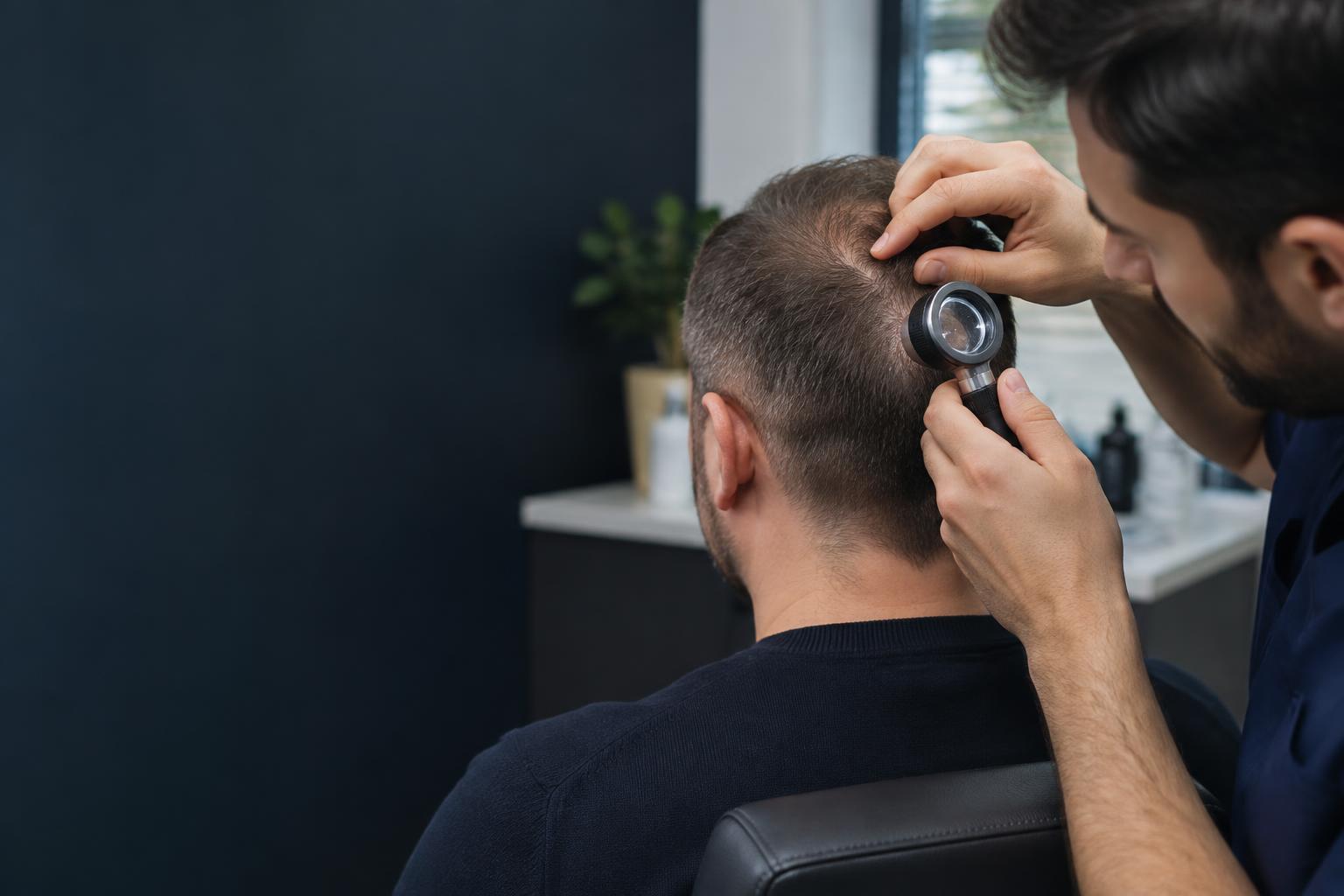
Magnified counting can assess density, hairs per unit, shaft-diameter diversity and miniaturisation. Samples should cover representative central and marginal points because one dense square does not describe the full zone. Calibration matters: a close-up without a known scale cannot produce an honest cm² measurement.
Hair coverage value also depends on calibre. Removing 20 coarse multi-hair units may change appearance more than removing 20 fine singles—or supply more visual mass to the recipient. Good records separate units, hairs and shaft quality rather than using one graft total as the entire assessment.
| Measure | What it describes | Common mistake |
|---|---|---|
| FU/cm² | Natural follicular groups in an area | Calling it hairs/cm² |
| Hairs/cm² | Individual shafts in an area | Ignoring grouping |
| Miniaturisation | Variation towards finer hairs | Counting unstable hair as permanent |
| Calibre | Diameter of shafts | Assuming every hair covers equally |
06 · Harvesting
The methods spend donor hair differently
FUE scores individual units with a punch and distributes many small scars through the harvesting field. FUT removes a strip, closes the wound and uses microscopy to divide the tissue into grafts. Both permanently transfer follicles; neither replenishes the donor. 26
FUE can suit short hairstyles because it avoids one linear scar, but ‘scarless’ is inaccurate. Removing units too close together creates visible low-density patches and overlapping punches increase tissue damage. Extending extraction far beyond stable boundaries can make a high one-day count look successful while weakening long-term reliability.
FUT concentrates removal within a strip and can yield many grafts while leaving surrounding density unpunched. Its trade-off is a line scar whose width depends partly on closure tension, strip dimensions and healing. Technique choice should sit inside a lifetime strategy, not replace one.
| Donor effect | FUE | FUT |
|---|---|---|
| Follicles removed | Individually across a field | Within one strip |
| Scar pattern | Multiple small dots | A linear scar |
| Main visible risk | Patchy diffuse depletion | Wide or raised line |
| Repeat planning | Prior extraction map matters | Laxity and prior scar matter |
07 · Central risk
What overharvesting looks like—and why a maximum is not a target
Overharvesting occurs when extraction density, spacing or boundaries leave an unacceptable donor appearance or compromise remaining supply. The common description is ‘moth-eaten’: islands of hair separated by pale, low-density or scarred patches. Severe cases can be difficult to disguise at any short length. 16
There is no universally accepted safe extraction percentage. Starting density, unit grouping, calibre, contrast, punch size, healing and planned hairstyle vary. Published models are aids, not a licence to extract the same fraction from everyone. The post-harvest density and spatial pattern matter more than a headline percentage.
Very aggressive extraction can also injure blood supply and, rarely, contribute to focal tissue necrosis. Repeat sessions need particular care because an old count may be missing and long hair can hide depleted zones. A surgeon should map previous scars and assume uncertainty rather than simply open a new field.
08 · Decades, not days
The donor must serve the hair loss you do not have yet
A successful frontal transplant can remain while untreated hair behind it continues to miniaturise. If the original design was low, dense and donor-hungry, there may be too little supply to connect it naturally to later loss. This is why age, current pattern, family history and treatment plans alter today's sensible graft number.
Conservative planning can mean a mature hairline, stronger priority for the front than crown, or postponing surgery until loss is clearer. It can also mean discussing evidence-based medical treatment with a qualified prescriber. Treatment may help native hair but cannot restore follicles already removed from the donor.
Preserving reserve is not wasted potential. It protects the ability to address progression, revise a scar or correct an unexpected result. Ask the surgeon to describe not only the proposed session but plausible plans if the crown expands or the sides recede over the following decades.
09 · Visual coverage
The same donor count can produce very different coverage
Coarse shafts cast a wider visual shadow than fine shafts. Curl or wave increases overlap, while straight fine hair separates more readily. Lower contrast between scalp and hair can reduce how strongly gaps register. These characteristics influence both the result and how much extraction the donor can visually tolerate. 12
Unit composition matters too. A donor rich in two- and three-hair groups may provide more shafts from the same graft count than one dominated by singles. However, single fine units remain important for a soft hairline, so the surgeon must allocate quality as well as quantity.
Measurements should therefore include hair count and calibre, not only follicular-unit density. Photographs at intended hair length and in strong, consistent light can reveal donor show-through that a close cropped sales image misses.
- Shaft diameter changes coverage
- Curl and wave change overlap
- Hair-to-skin contrast changes scalp visibility
- Hairs per follicular unit change yield
- Hairstyle changes how scars and thinning show
10 · Secondary sources
Extra sources can supplement—but not recreate—the scalp donor
Beard hair can supplement scalp grafts in selected advanced-loss and repair cases. It is often coarser and grows as single-hair units, which can add bulk behind a scalp-hair hairline. Extraction also creates facial scars, so beard density, skin type and shaving preference need explicit discussion. 17
Chest and other body hair tends to have different length, calibre and growth cycles. Outcomes are less predictable and the evidence base is smaller. These follicles largely retain their original characteristics after transfer rather than transforming into ordinary scalp hair.
Non-scalp hair should not be used to make an unsuitable scalp donor appear unlimited. It is a specialised secondary resource. Ask for comparable cases showing both the donor site and recipient result at long follow-up, and discuss what happens if texture does not blend.
11 · Revision
Repair starts with an honest inventory of what remains
Previous FUE can leave thousands of scattered scars even when the donor looks full at styling length. Previous FUT may leave one or more lines and reduced laxity. A repair assessment should document both, request old records and estimate residual stable density before proposing more extraction. 18
Options depend on the problem. Small numbers of grafts may camouflage a widened line; scalp micropigmentation may reduce contrast; carefully distributed extraction can sometimes rebalance an obvious pattern. Each intervention spends resources or changes future options, and none restores the original density.
Poorly angled or plug-like recipient grafts can sometimes be removed and re-used, but survival is not assured and new scarring is created. The repair goal may be improvement rather than perfection. A cautious surgeon will say when camouflage or accepting the current position is safer than another large operation.
- Obtain the previous operative graft count
- Photograph the donor shaved or parted
- Map FUE scars and FUT lines
- Measure residual density and miniaturisation
- Agree a realistic repair priority
12 · Safety
Registration is the floor, not the finish line
In England, providers and premises undertaking hair transplant surgery should be CQC-registered. Other UK nations have their own systems. Check the exact location rather than a brand's head office, and read available inspection information. 15
The operating doctor should hold GMC registration and a licence to practise. GMC guidance requires competence, realistic information, personal responsibility for consent and time for reflection. BAHRS is a professional membership body, not a statutory regulator; membership can be informative but does not replace independent checks. 34
Joint UK and Turkish professional guidance says planning should be agreed in advance with the doctor who performs the surgery. This is especially relevant to donor extraction, where a technician-led production model can obscure who made thousands of surgical incisions. 10
13 · Evidence in images
Look at the donor, not only the new hairline
Hairline photographs dominate advertising because they show the desired change. They cannot demonstrate responsible harvesting. Request donor images before surgery and after healing, photographed in bright light with comparable hair length, angle and exposure.
A long hairstyle can hide both FUE depletion and a FUT line. Ask for examples close to the length you wear or expect to wear. For repeat FUE, a short donor view can reveal extraction spacing and whether the zone extends into unstable margins.
Selected transformations do not establish complication rates or average outcomes. Ask how many relevant procedures the surgeon performs, what donor complications occur and whether the images show the named surgeon's own consecutive patients rather than anonymous work from a clinic network.
- Same lighting and camera distance
- Dry hair, similarly styled
- Back and both side views
- Relevant hair length
- At least 12-month follow-up where possible
14 · Reality check
Six donor-area myths corrected
The donor area is often described in reassuring absolutes. In reality, permanence is probabilistic, scarring exists with every incision and visible coverage—not the extraction count—is the meaningful endpoint.
| Myth | Evidence-led correction |
|---|---|
| FUE is scarless | It creates many small round scars |
| Donor hair grows back | Extracted follicles are permanently moved |
| The safe zone is identical for everyone | It needs individual adjustment |
| A large donor means unlimited grafts | Density and future demand still limit supply |
| A photo proves suitability | Magnified examination and diagnosis matter |
| Body hair becomes scalp hair | It retains donor characteristics |
15 · Take this with you
Questions that protect your donor supply
A good answer includes a measurement, method or named person. ‘You have a strong donor’ is an impression; ‘we counted units and hairs at these points, checked miniaturisation and mapped this boundary’ is a plan you can interrogate.
Ask what happens if the safe yield is lower on the day than the quote assumed. The correct answer should prioritise safety and obtain consent for any material change—not extend into riskier margins to fulfil a prepaid number.
Take time to compare written plans. GMC guidance supports reflection rather than pressure. Decline countdown discounts, a consultation conducted only by sales staff or a refusal to name the clinician before payment. 4
- What is my diagnosis and likely progression?
- What are my FU/cm² and hairs/cm² at several points?
- Is there donor miniaturisation?
- Where are my personalised safe boundaries?
- What density will remain after extraction?
- Who makes every donor incision?
- How much reserve remains for later life?
- Can I see healed donors like mine?
- What follow-up covers donor complications?
16 · Decision
A protected donor is part of a successful result
A transplant can improve the front while permanently worsening the back. That is why success must include both recipient appearance and donor preservation. Count the follicles left behind as carefully as those moved.
No chart, online photo or package can determine your safe supply. It requires diagnosis, magnified measurements, personalised boundaries and a plan for progression. The best plan may use fewer grafts, a higher hairline, staged treatment or no surgery.
Choose a clinician willing to explain uncertainty and document the donor. A lifetime resource deserves more than a one-day sales target.
17 · Common questions
30 donor area FAQs
01What exactly is the donor area?+
The donor area is the hair-bearing scalp from which follicular units are removed for transplantation. It is usually centred on the back and sides, but its safe boundaries are personal. The whole back of the head should not automatically be treated as permanent.
02Why is hair taken from the back and sides?+
Follicles in a suitable occipital and side zone are generally more resistant to androgen-driven miniaturisation than follicles on top. This donor dominance tends to continue after relocation, although no boundary is guaranteed for every lifetime.
03What is the safe donor area?+
It is an estimated zone with the greatest probability of retaining hair in advanced pattern loss. The classic map came from older-patient population data. A surgeon must adapt it to age, family history, miniaturisation and the individual pattern.
04Is the safe donor area completely permanent?+
No. ‘Safe’ describes probability, not certainty. Some people develop thinning at the margins or diffuse miniaturisation. A conservative extraction stays inside personalised boundaries and preserves a reserve rather than treating a textbook outline as a guarantee.
05Can my donor area run out?+
Yes. Removed follicles do not regenerate in their original positions. The remaining hair may disguise extraction, but every graft spends part of a finite supply. Overharvesting can leave permanent low density, visible dots and little flexibility for repair.
06What does donor density mean?+
It is the number of follicular units or hairs in a measured area, usually one square centimetre. Both units must be stated: 70 follicular units can contain very different hair totals depending on the person's mix of single- and multi-hair groups.
07What is a normal donor density?+
One influential study reported approximately 65–85 follicular units and 124–200 hairs per cm² in its sample. That is a research range, not a pass mark. Population, measurement method, scalp region and individual biology all produce variation.
08How is donor density measured?+
Clinicians can use magnification, trichoscopy or calibrated photographs to count units and hairs within a known area. Useful assessment samples several points, records miniaturisation and hair calibre, and maps previous FUE scars rather than relying on a quick photograph.
09What is donor miniaturisation?+
Miniaturisation is the progressive reduction in shaft diameter associated with pattern hair loss. Significant variation or many fine hairs within a proposed donor zone may mean it is unstable, reducing both safe supply and confidence in long-term survival.
10What is diffuse unpatterned alopecia?+
It describes diffuse thinning that also affects the back and sides rather than respecting a stable pattern. Because the presumed donor is involved, surgery may be unsuitable. The terminology and thresholds are still evolving, so specialist dermatological assessment matters.
11Does FUE leave donor scars?+
Yes. Every FUE punch creates a small round wound and scar. These may be subtle when the punch is small and harvesting is well distributed, but very short hair, contrast, healing and high extraction density can make them visible.
12Does FUT damage the donor area?+
FUT removes a strip permanently and leaves a linear scar. It can harvest many grafts without thinning the entire donor field, but scar width and comfort vary with closure, strip width, scalp laxity and healing.
13Which method preserves more donor hair?+
There is no universal answer. FUT and FUE use the donor differently. A long-term strategy may favour one or combine them, depending on laxity, hairstyle, prior surgery, likely future demand and the surgeon's ability to harvest conservatively.
14What is overharvesting?+
Overharvesting means removing too many units, taking them too close together or extracting outside stable boundaries so the remaining area looks thin or patchy. It is not defined by one universal graft number because density and coverage differ.
15Can an overharvested donor area recover?+
Removed follicles do not regrow. Temporary shock shedding may recover, but permanent depletion does not reverse naturally. Longer styling, scalp micropigmentation or carefully selected repair grafts may camouflage it; each has limitations and requires assessment.
16How much can safely be extracted by FUE?+
No single percentage or graft number is safe for everyone. The decision depends on starting density, hair calibre, punch size, spacing, safe-zone dimensions, prior scars and future needs. A package maximum is not an anatomical limit.
17Why does scalp laxity matter for FUT?+
A strip wound closes under tension. The surgeon considers how readily the scalp moves and stretches when choosing strip dimensions. Excess tension can contribute to a wider scar, while very loose tissue does not make every large harvest appropriate.
18Does age change donor planning?+
Yes. A younger person's eventual loss pattern is less certain, so apparent donor margins and future recipient demand are harder to predict. Conservative designs, treatment of ongoing loss or delaying surgery may preserve options over decades.
19Does family history help predict supply?+
It provides context but cannot map your future with certainty. Photographs and patterns in close relatives may suggest advanced loss risk. They should be considered alongside current examination, progression, age and measured donor miniaturisation.
20Do hair calibre and curl matter?+
Very much. Coarser or curlier shafts can create more visual coverage per hair, while fine straight hair may need more units for the same appearance. Curl below the skin can also make FUE extraction technically more demanding.
21Can grey donor hair be transplanted?+
Yes. Grey follicles can be transplanted, although identifying and sorting pale shafts may require suitable lighting or temporary colouring. Low hair-to-scalp contrast can sometimes improve the appearance of coverage even when numeric density is modest.
22Can beard hair replace scalp donor hair?+
It can supplement scalp follicles in selected advanced or repair cases, usually through FUE. Beard hair is commonly coarser and often single-haired, so it is normally blended behind a scalp-hair hairline rather than treated as identical material.
23Can chest or body hair be used?+
Selected body hair may provide supplementary grafts, but growth cycles, length, calibre, curl and predictability differ. Published evidence is more limited than for scalp hair. A test or cautious role may be appropriate rather than a guaranteed substitute.
24Does body hair become scalp hair after moving?+
No. Evidence indicates transplanted beard and body follicles largely retain their original calibre, curl, colour and growth behaviour. Placement must account for those characteristics so they blend rather than draw attention.
25What if I have already had FUE elsewhere?+
Obtain the operative graft record if possible. A new clinician should map scars, measure residual density and assess whether previous extraction crossed safe boundaries. Guessing from long hair can underestimate what has already been spent.
26Can donor scars be repaired?+
Sometimes. Options may include placing limited grafts into a widened strip scar, redistributing hair around depleted zones, scalp micropigmentation or scar revision. Repair uses remaining resources and cannot recreate untouched donor density.
27Who should perform donor extraction in the UK?+
UK professional guidance treats donor punch incisions and strip removal as surgery for an appropriately trained, licensed doctor. Ask who personally performs each step and check the doctor's GMC status and the premises' regulator registration.
28Do English clinics need CQC registration?+
Providers and locations undertaking hair transplant surgery in England should be registered with the Care Quality Commission. Scotland, Wales and Northern Ireland have different regulators. Registration is a legal baseline, not proof of artistic or surgical quality.
29Can a clinic assess my donor from photos alone?+
Photos can support an initial conversation but cannot reliably replace examination, magnified density counts, miniaturisation assessment and scalp evaluation. Treat a precise remote graft promise as provisional until the operating doctor examines you.
30What should I ask about my donor area?+
Ask for measured unit and hair density, miniaturisation, personalised safe-zone boundaries, proposed extraction map, expected postoperative density, clinician roles, remaining lifetime reserve, scar examples at your hairstyle and a plan if safe yield is lower than expected.
Keep reading
Related guides
18 · Sources
References and evidence notes
Sources were accessed on 6 October 2026. This guide distinguishes professional guidance and peer-reviewed evidence from illustrative claims. Evidence cannot predict an individual result.
- 1NHS: Hair transplant
UK patient guidance on suitability, procedure, recovery, risks, costs and checks.
- 2BAPRAS: Hair transplant surgery
Professional-body explanation of follicular units, FUE, FUT and surgical planning.
- 3BAHRS: Patient advice
UK specialist guidance on surgical roles, clinic checks and misleading claims.
- 4General Medical Council: Cosmetic interventions
Standards for competence, consent, reflection time and responsible marketing.
- 5Care Quality Commission: Surgical procedures: scope of registration
Registration requirements for surgical providers in England.
- 6ISHRS: FUE clinical practice guidelines
Specialist guidance on donor assessment, harvesting, handling and implantation.
- 7StatPearls: Hair transplantation
Peer-reviewed clinical overview of anatomy, candidacy, technique and complications.
- 8Parsley & Perez-Meza: Factors affecting growth and survival of follicular grafts
Peer-reviewed review of handling, hydration, temperature and out-of-body time.
- 9Aesthetic Plastic Surgery: Complications following hair transplantation
2025 systematic review and meta-analysis of reported complications.
- 10BAPRAS, BAAPS, BAHRS & TSPRAS: Minimum guidelines for hair transplant surgery
Joint guidance on doctor-led planning, consent and surgical responsibilities.
- 11ISHRS: Questions to ask your hair doctor
Patient guidance on scars, clinician identity, experience and outcomes.
- 12ISHRS: Top five things to know about hair transplantation
Specialist explanation of finite donor supply and realistic expectations.
- 13Unger et al.: Delineating the safe donor area for hair transplanting
Foundational 1994 study mapping probable permanent donor boundaries in 328 older patients.
- 14Jiménez & Ruifernández: Distribution of human hair in follicular units
Peer-reviewed donor-density study and mathematical model.
- 15Issa & Tosti: Trichoscopy for the hair transplant surgeon
Clinical review of magnified scalp and donor assessment.
- 16Keene, Rassman & Harris: Determining safe excision limits in FUE
Professional-journal discussion of donor depletion and the absence of one universal limit.
- 17Poswal et al.: Use of body and beard donor hair
35-patient observational study on non-scalp donor characteristics.
- 18ISHRS: Revision and repair of bad hair transplants
Specialist overview of repair options and donor limitations.