
01 · Answer first
There is no safe one-size-fits-all number
A typical estimate can run from several hundred grafts for a small hairline adjustment to several thousand for wider front-to-crown loss. But no reputable medical body publishes a definitive graft chart. A stage or selfie cannot show whether your donor area can safely supply the figure being advertised.
Area
How many square centimetres need useful coverage?
Density
How many units per cm² are planned in each zone?
Supply
How many units can your donor safely spare over a lifetime?
02 · The basic unit
A graft is not the same as a hair
Modern transplantation usually moves naturally occurring follicular units. One unit may contain one, two, three or occasionally more hairs. Hairline edges tend to use singles; multi-hair grafts can build visual mass behind them.2
That distinction makes headline numbers incomplete. Two people can each receive 2,000 grafts yet receive different hair totals. If one averages 1.8 hairs per graft and the other 2.3, their procedures move about 3,600 and 4,600 hairs respectively. Growth, calibre and placement still determine the result.
03 · The method
How a graft estimate is built
- 01
Confirm the diagnosis
Pattern hair loss, diffuse thinning, scarring alopecia and temporary shedding do not share the same surgical plan.
- 02
Map the recipient area
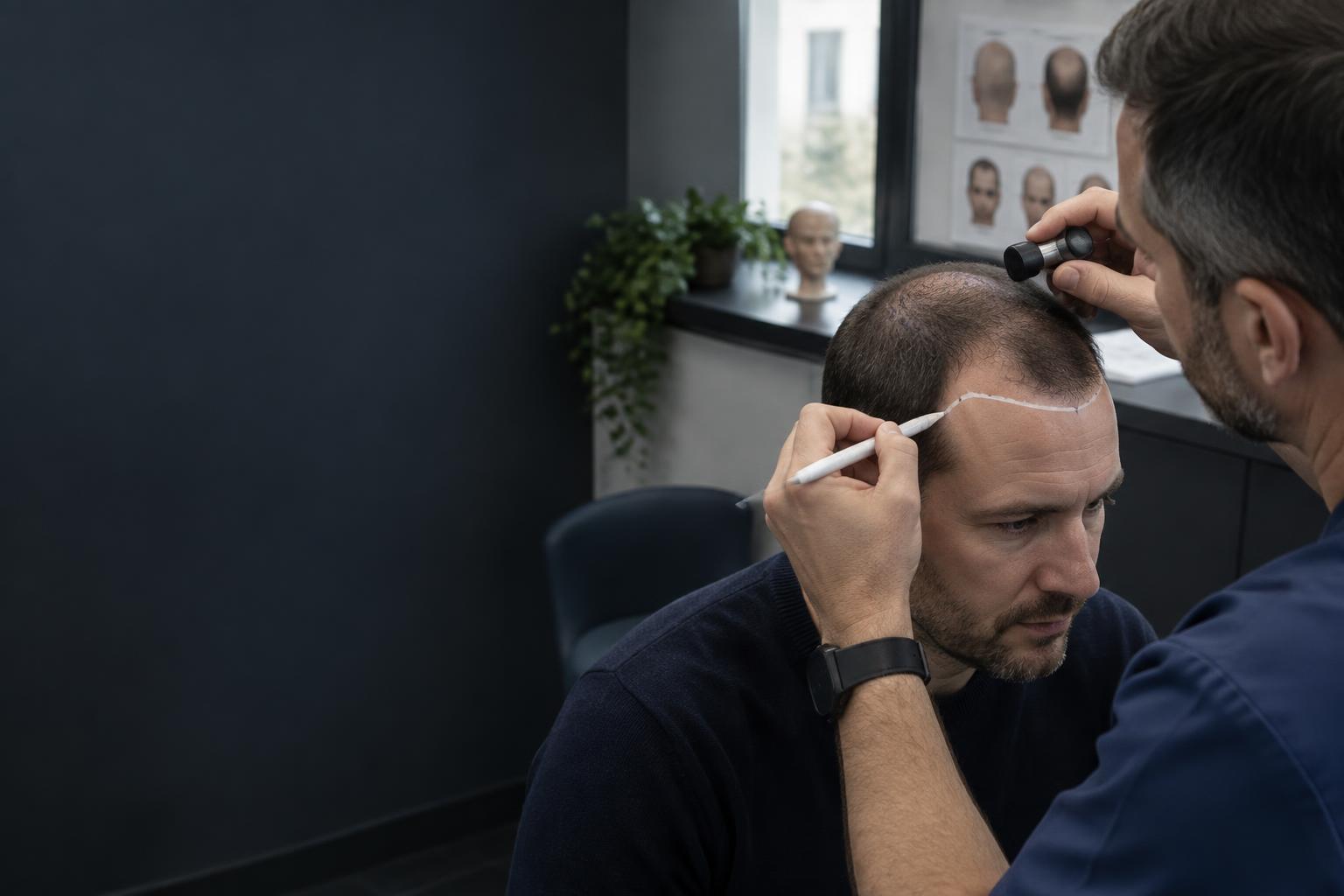
The surgeon measures the frontal zone, mid-scalp, crown and any scars separately.
- 03
Assess what is already there
Existing miniaturised hair changes both the density required and the risk of further loss.
- 04
Choose a design and density
A lower hairline or densely packed crown materially increases demand.
- 05
Measure the donor
Density, hair grouping, calibre, miniaturisation, safe-zone boundaries and previous scars set the ceiling.
- 06
Reserve for the future
The final plan should account for likely progression rather than spending every available unit today.
Guidelines stress that candidacy and planning are individual. They are minimum standards, not a substitute for clinical judgement.4
04 · Orientation only
Indicative graft ranges by pattern
The ranges below synthesise common commercial planning charts to explain scale. They are not NHS, BAPRAS or ISHRS recommendations, and they should not be used to book surgery without examination.12
| Area or pattern | Often quoted range | Why it varies |
|---|---|---|
| Small temple recession | 500–1,000 | Temple depth, asymmetry and hairline shape |
| Receding frontal hairline | 800–1,500 | Width, lowering and existing forelock |
| Front and temples | 1,500–2,500 | Surface area, density and temple-point work |
| Small crown | 800–1,500 | Diameter, whorl and existing hair |
| Front plus mid-scalp | 2,500–3,500 | Head size and density allocation |
| Broad front-to-crown loss | 4,000–6,000+ | Often exceeds one-session or donor limits |
Norwood-Hamilton and Ludwig stages describe visible patterns; they do not measure area or safe donor capacity. Quantitative systems have been proposed precisely because visual staging alone is imprecise for surgical planning.8
05 · The arithmetic
Worked examples: area × planned density
A clinic may begin with a simple planning equation: recipient area in cm² × planned follicular units per cm² = graft estimate. It is a planning aid, not a home calculator, because both inputs require judgement.
Example A: frontal zone
A mapped 45cm² zone planned at an average 35 FU/cm² gives 1,575 grafts. The front edge may use lower-density singles while more multi-hair units sit behind it.
Example B: existing thinning hair
A 60cm² mid-scalp already containing useful native hair may not need 35 new units in every square centimetre. Placement between fragile hairs also raises shock-loss and progression questions.
Example C: front and crown compete
If the front suggests 2,200 grafts and the crown 1,800, the arithmetic says 4,000. A measured lifetime donor plan may support only 3,000 now, so the surgeon must discuss priorities or staging.
Clinics differ in how they trace irregular areas and choose density. A quote should show the marked zones and allocation, rather than presenting a calculator output as certainty.
06 · The limiting factor
Your donor area sets the ceiling
The back and sides are not an unlimited bank. FUE permanently removes selected follicular units; FUT removes a strip and closes the gap. Safe capacity depends on the true stable zone, follicular-unit density, hair-shaft diameter, miniaturisation, scalp size, scars and the density that must remain.35
Published donor-management work cautions that assuming a fixed “permanent” quarter of the scalp can overestimate supply in advanced patterns. Donor hair can also thin with age.7 A plan that looks possible at 25 may be poor at 45 if it ignores progression.
07 · What the number misses
Why the same graft count can create different coverage
Hair calibre
Coarser shafts usually block more light than fine hair.
Curl and wave
Curved hair can create more apparent volume across an area.
Hair-to-scalp contrast
Lower contrast can make scalp show-through less obvious.
Hairs per graft
A higher average can add bulk, while singles remain vital at the edge.
Growth and handling
A planned graft that does not survive contributes no coverage.
Styling and light
Length, direction and overhead light change the visible result.
Hair coverage value attempts to combine density and shaft diameter rather than treating all donors as equivalent. It is a useful concept, but measurement methods and safe thresholds are not globally standardised.56
08 · Visual strategy
Hairline, mid-scalp or crown: where grafts work hardest
The front frames the face and is visible in ordinary conversation, so it often receives priority when supply is limited. Natural hairlines use irregular single-hair grafts at the leading edge, with density and multi-hair units building behind.
The crown can absorb many grafts because it may cover a broad circle and hairs must follow a whorl. Spreading a limited supply thinly from forehead to crown can leave every zone see-through. A conservative plan may restore the front, blend the mid-scalp and leave the crown lighter.
09 · Lifetime planning
Plan for the hair you may lose next
A transplant redistributes follicles; it does not stop pattern hair loss in native hair. Progression is variable, which is why a surgeon should consider age, family pattern, miniaturisation and response to treatment rather than design only around today's photograph.
Suitable patients may discuss medical treatment with a qualified prescriber. Stabilising native hair can change timing and reduce the area that needs surgery, but benefits, side effects and contraindications need individual review.
A first procedure should work as a stand-alone design. Staging can be sensible when the area is extensive, donor supply is uncertain or the team wants to see how loss and growth evolve. The NHS notes that the full result is generally assessed at 12–18 months.1
10 · Individual anatomy
Women, diffuse loss and tightly curled hair
Women and diffuse thinning
A Ludwig stage alone cannot confirm candidacy. Diffuse loss may extend into the donor area, and causes such as thyroid disease, nutritional deficiency, traction or inflammatory alopecia may need investigation. Magnified assessment is more important than forcing the pattern into a graft chart.
Afro-textured and tightly curled hair
Curly shafts can provide strong visual coverage per graft, but follicles may curve beneath the skin, making FUE extraction technically more demanding. Ask for clear donor and recipient results in patients with genuinely comparable hair and who performed the extraction.
Fine hair
Fine hair generally contributes less visual bulk per graft. Trying to compensate with a very high count can be unsafe if donor density is also modest; design and realistic expectations matter.
11 · Reassessment
Previous transplants and repair cases
A second estimate should begin with records from the first procedure: graft and hair counts, extraction method, punch pattern or strip scar, treated zones and growth. If records are missing, the new surgeon must estimate what was removed and what remains.
Repeat FUE is particularly difficult to plan after uneven harvesting because apparent density may conceal scars and transected follicles. Repair may also need grafts for an unnatural hairline or scar, leaving fewer for untreated loss.
Be cautious if a clinic quotes a large second session from photographs alone. Bright-light donor inspection, magnification and density measurements are more informative than the previous invoice.
12 · Harvest method
Does FUE or FUT change the number available?
FUE takes individual units across a donor zone. FUT removes a strip, then technicians dissect it under magnification. Neither automatically creates more donor hair. Yield depends on anatomy, transection, safe extraction or closure and how the methods fit a lifetime sequence.
FUT may obtain a substantial number from a defined strip while preserving wider zones for possible later FUE. FUE avoids a linear scar but reduces density wherever units are taken. The better plan depends on haircut, scalp laxity, existing scars, graft requirement and priorities — not only a maximum session claim.
Ask who performs the surgical steps. Joint UK and Turkish professional guidance says planning should be agreed with the doctor performing surgery and warns against surgical tasks being delegated inappropriately to technicians.9
13 · Take this list
Ten questions to ask about your graft plan
- 01What is my diagnosis, and is the loss stable?
- 02What area in cm² are you proposing to treat?
- 03How many grafts go to each named zone?
- 04What density are you planning in each zone?
- 05What is my donor density and miniaturisation?
- 06How did you calculate my safe lifetime supply?
- 07What average hairs per graft do you expect?
- 08Who performs extraction and recipient incisions?
- 09What remains if my native hair keeps thinning?
- 10What happens if fewer safe grafts are obtained?
In England, check the clinic on the CQC register and the operating doctor's GMC registration and licence. Read the inspection report rather than treating registration as a quality award.110 Other UK nations have different healthcare regulators.
14 · Sales claims
When a graft quote should worry you
- A guaranteed number before anyone examines the donor area.
- A package sold by maximum grafts rather than an agreed design.
- The same recommendation for every person at a Norwood stage.
- No breakdown between hairline, front, mid-scalp and crown.
- No explanation of residual donor density or future loss.
- Counting hairs as grafts, or changing terminology during the sale.
- Pressure to pay before meeting the operating doctor.
- Guaranteed density, growth or a ‘scarless’ donor area.
GMC standards require realistic information and responsible marketing for cosmetic interventions.11 A responsible surgeon may reduce the proposed number, stage treatment or advise that surgery is not appropriate.
15 · Common questions
30 hair graft FAQs
01How many grafts do I need for a hair transplant?+
There is no reliable answer from a photograph or hair-loss stage alone. A surgeon needs to measure the area to treat, assess donor density and miniaturisation, examine hair calibre and grouping, agree a realistic density and plan for future loss. Published clinical bodies do not endorse one universal graft chart.
02What is one hair graft?+
A graft is usually one naturally occurring follicular unit. It may contain one, two, three or occasionally more hairs. This is why 2,000 grafts does not mean 2,000 hairs, and why clinics should ideally record both graft and hair counts after surgery.
03How many hairs are in 2,000 grafts?+
It depends on your follicular-unit distribution. If the average is 2.1 hairs per graft, 2,000 grafts would contain about 4,200 hairs. That is an illustration, not a prediction: individual averages vary, and single-hair grafts are deliberately selected for a natural hairline.
04Is there an official graft calculator?+
No NHS, BAPRAS or ISHRS calculator can safely prescribe your number online. Commercial calculators can help explain why a larger area generally needs more grafts, but they cannot examine donor stability, scalp disease, hair shaft diameter or future loss.
05How do surgeons calculate a graft estimate?+
A useful estimate combines the recipient area's measured surface area, existing hair, planned follicular units per square centimetre, donor capacity and the visual coverage created by your hair. The surgeon should then adjust the design for age, likely progression and priorities.
06How accurate is the Norwood scale for graft planning?+
Norwood-Hamilton is useful for describing common male-pattern hair-loss shapes, but it does not measure square centimetres or donor quality. Two people at the same stage may have different head sizes, hairlines, crown areas and hair characteristics, so their estimates can differ substantially.
07Can the Ludwig scale tell a woman how many grafts she needs?+
No. Ludwig describes a pattern of female hair loss but does not establish donor stability or surgical suitability. Diffuse thinning may also affect the back and sides, so diagnosis and magnified donor examination are particularly important before discussing numbers.
08How many grafts are needed for a receding hairline?+
A limited frontal recession may be planned with roughly 800–1,500 grafts in some clinic charts, but this is only an orientation. Hairline position, temple work, width, existing density, hair calibre and the need to preserve donor hair can move the number considerably.
09How many grafts are needed for the front and temples?+
Commercial planning ranges often place broader frontal and temple restoration around 1,500–2,500 grafts. The true figure depends on the area and design. Lowering a hairline by even a small distance can add a surprisingly large surface area and graft requirement.
10How many grafts are needed for the crown?+
Small crowns may use around 800–1,500 grafts, while a broad crown can consume 2,000 or more. These are not clinical standards. The crown's spiral pattern and large surface area make it graft-hungry, so surgeons may prioritise the front when donor supply is limited.
11How many grafts are needed for advanced hair loss?+
Advanced front-to-crown loss may exceed what one operation or even the lifetime donor supply can cover densely. Online charts commonly show 4,000–6,000-plus grafts, but a safe plan may use fewer, stage treatment, concentrate on the front, or advise against surgery.
12Are 3,000 grafts a lot?+
It is a substantial procedure, but whether it is appropriate depends on the size of the donor area, extraction pattern, technique, team and recipient plan. The number is not automatically excessive or adequate. Ask what residual donor density is expected afterwards.
13How many grafts are too many in one session?+
There is no universal cut-off. Safety depends on donor density, extraction distribution, strip dimensions and closure for FUT, graft handling time, staffing, procedure length and your health. A clinic should justify the number from measurements rather than advertise a maximum package.
14What is the safe donor area?+
It is the zone at the back and sides judged most likely to retain hair over time. Its boundaries vary between people and can shrink with advanced loss or ageing. Taking grafts outside a genuinely stable zone risks transplanting follicles that may later thin.
15What is overharvesting?+
Overharvesting means removing enough follicular units, or concentrating removals so unevenly, that the donor area becomes visibly thin, patchy or scarred. Extracted follicles do not grow back in the donor site. Prevention through measurement and distribution is more reliable than repair.
16Can overharvesting be fixed?+
Sometimes it can be camouflaged with scalp micropigmentation, longer hair, beard or body-hair grafts, or carefully placed scalp grafts if supply remains. None restores the original donor reserve, and repair can be difficult. An independent assessment is sensible before another procedure.
17Does thicker hair mean I need fewer grafts?+
Often it creates more visual coverage per surviving graft because each shaft blocks more light, but it does not create an automatic discount. Hair direction, curl, colour contrast, recipient area and the number of hairs in each unit also affect the result.
18Does curly hair provide more coverage?+
Curl or wave can increase the apparent volume and coverage produced by a given number of hairs. Tightly curled follicles can also be technically harder to extract by FUE because the curve continues below the skin, so surgeon experience with comparable hair is important.
19Does hair colour affect the graft number?+
Colour contrast affects how readily the scalp shows through. Dark straight hair against pale scalp may reveal gaps more than a lower-contrast combination. It is one part of the visual plan, alongside shaft diameter, curl, styling and lighting.
20Why might a surgeon recommend fewer grafts than I want?+
They may be protecting a limited donor reserve, allowing for future loss, avoiding an unnaturally low hairline, reducing overharvesting risk or prioritising the area that will make the greatest visual difference. A lower number can reflect a more responsible lifetime plan.
21Why do two clinics quote different graft numbers?+
They may draw different hairlines, measure different areas, assume different densities or include the crown differently. They may also estimate donor capacity differently. Ask each clinic to mark the proposed area and state grafts by zone, not just give one headline total.
22Will I need a second hair transplant?+
Possibly. Native hair can continue to thin, and one safe session may not provide every desired improvement. A good first plan should still look coherent on its own and preserve options. No clinic can promise that you will never want or need further treatment.
23How long should I wait between sessions?+
The scalp and donor area need time to heal, and the first result needs time to mature before density is judged. The NHS says a full result is generally seen at 12 to 18 months. Your surgeon should set timing according to healing, growth and donor reassessment.
24Can medication reduce the number of grafts I need?+
Medical treatment may stabilise or improve native hair in suitable patients, which can change the surgical area or timing. It cannot manufacture donor grafts. Finasteride and minoxidil have different benefits, risks and contraindications, so discuss them with an appropriate prescriber.
25Does FUE give more grafts than FUT?+
Not automatically. FUE distributes individual extractions; FUT obtains follicles from a strip. Yield depends on anatomy, safe harvesting, transection and long-term strategy. In selected patients, FUT may preserve wider donor zones for later FUE, but neither method guarantees more usable grafts for everyone.
26Can beard or body hair increase my graft supply?+
It may supplement scalp hair in selected repair or advanced cases, but its growth cycle, calibre, texture and cosmetic behaviour differ. It is not a like-for-like substitute for scalp hair, especially at the front hairline, and requires relevant surgical experience.
27Can women have a 3,000-graft transplant?+
The number alone cannot establish safety. Many women have diffuse loss that may involve the donor area, while others have stable localised patterns. A large procedure should follow diagnosis, donor mapping and discussion of temporary shedding and future thinning.
28How does a previous transplant affect my estimate?+
The clinician needs the old graft total if available, donor scars, extraction pattern, residual density, hairline design and growth outcome. Previous surgery can reduce supply and make estimates less certain, particularly after undocumented or uneven FUE harvesting.
29Should I choose a clinic that promises the most grafts?+
No. More grafts can increase coverage only when they are safely harvested, handled well and placed into a sensible design. An unusually high promise without donor measurements may signal overharvesting risk or sales-led planning.
30What should a written graft plan include?+
It should identify the diagnosis, recipient zones and areas, grafts allocated to each zone, expected donor method, scar pattern, who performs each step, likely future loss, alternatives, limitations, aftercare and what happens if the planned number cannot be safely obtained.
16 · Sources
References and evidence notes
Sources were accessed on 30 September 2026. Graft-range charts are not validated prescribing tools; the one commercial source is identified and used only for orientation. Professional guidance and specialist research do not replace individual assessment.
- 1NHS: Hair transplant
UK patient guidance on candidacy, procedure, results, risks, costs and clinic checks.
- 2BAPRAS: Hair transplant surgery
Professional-body guidance on assessment, FUE, FUT and recipient-site planning.
- 3ISHRS: FUE Clinical Practice Guidelines
Guidance on donor assessment, candidacy, harvesting and complications.
- 4Avram et al.: Hair Transplant Practice Guidelines
Consensus guidance; recommendations are minimum standards and patient assessment remains individual.
- 5Keene, Rassman & Harris: Determining Safe Excision Limits in FUE
Specialist-journal discussion of donor density, hair coverage value and overharvesting.
- 6Garg & Garg: Safe Donor Follicle Harvesting
2024 review of safe donor areas, residual density and extraction planning.
- 7Carman & Rassman: FUE Donor Area Management
2024 review emphasising finite, ageing donor supply and long-term planning.
- 8Pittella et al.: PRECISE Scale for Pattern Hair Loss
Peer-reviewed proposal for quantitative recipient-area classification beyond visual stages.
- 9BAPRAS, BAAPS, BAHRS & TSPRAS: Minimum guidelines for hair transplant surgery
Joint 2023 safety statement on doctor-led planning and surgical responsibilities.
- 10Care Quality Commission: Choosing cosmetic surgery
How to check providers and make an informed choice in England.
- 11General Medical Council: Cosmetic interventions: key points
Standards for consent, realistic outcomes, competence and responsible marketing.
- 12Bernstein Medical: Graft numbers
Commercial planning examples used only to contextualise indicative ranges; not an official standard.