
01 · Answer first
FUE is an extraction method—not a guarantee of quality
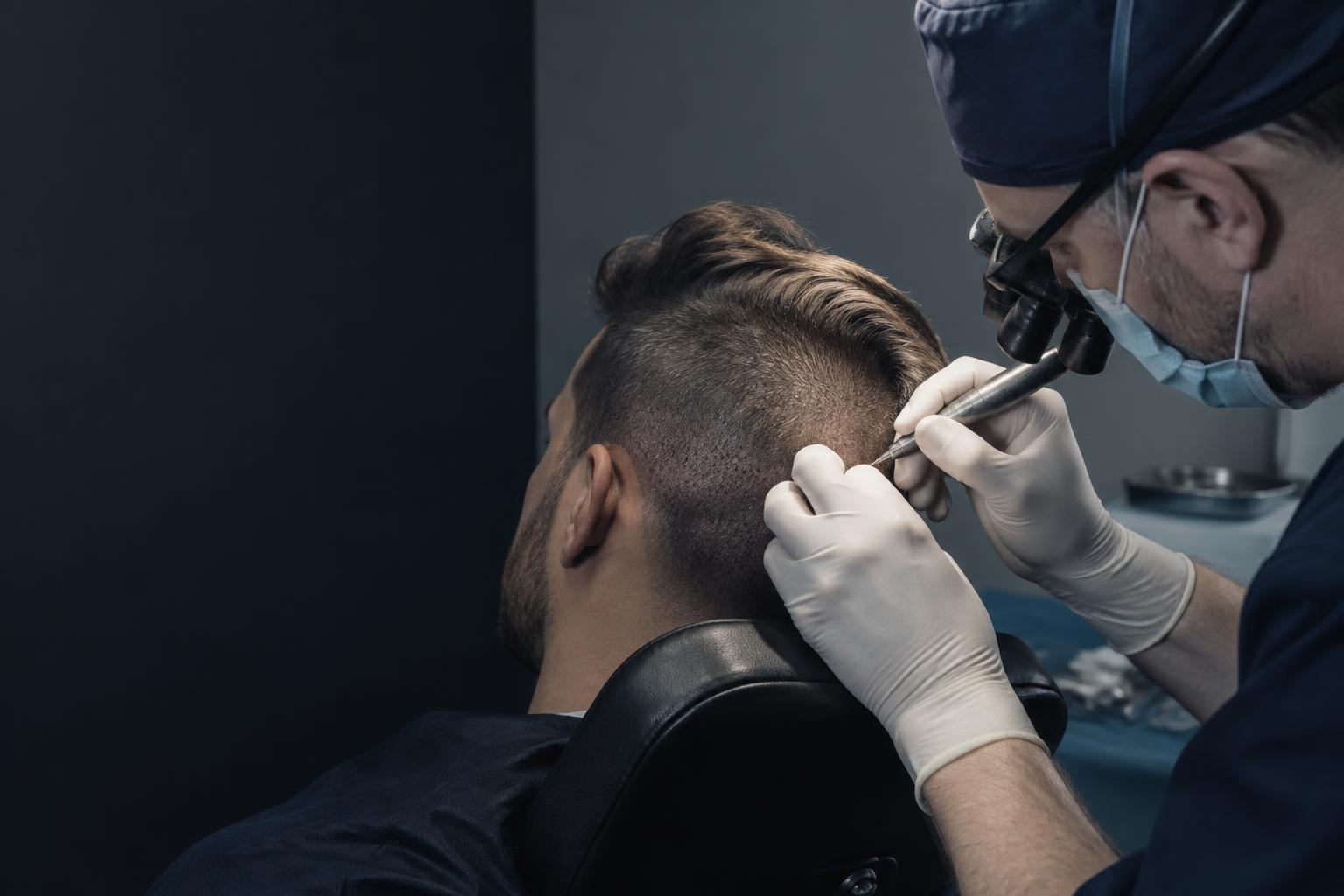
FUE stands for follicular unit excision. An operator uses a small punch to score around natural groups of follicles in a stable donor area, then removes those grafts individually. Recipient sites are created in thinning areas and the grafts are placed into them. 2613
The acronym describes only the way follicles leave the donor scalp. It does not tell you who diagnosed the loss, who performs the incisions, whether the donor boundary is safe, how grafts are stored or whether the hairline is well designed. These decisions can matter more than whether a punch is manual, motorised or robotic.
FUE leaves many small round scars rather than the linear scar associated with FUT. It is not scarless and the follicles do not grow back in the donor. A good procedure therefore protects both the new hairline and the appearance of the area used to create it.
02 · Translation
FUE, DHI, sapphire and robotic: what the labels really describe
FUE concerns harvesting. ‘DHI’ commonly describes placing grafts with an implanter pen, although the follicles may still have been harvested by FUE. ‘Sapphire’ usually refers to blade material used for recipient sites. Robotic or automated systems assist selected harvesting steps. None creates a new kind of follicle.
This distinction helps when comparing quotes. One clinic may advertise ‘Sapphire DHI FUE’ while another says ‘FUE with implanter placement’; their actual workflows may overlap. Ask for each stage in plain English and the named person responsible.
Device choice can affect ergonomics, incision shape or workflow, but promotional claims often run ahead of comparative evidence. A tool cannot compensate for an unstable diagnosis, depleted donor, poorly angled sites or rushed handling.
| Label | Usually refers to | It does not prove |
|---|---|---|
| FUE | Individual punch harvesting | Scar-free surgery |
| DHI | Implanter-assisted placement | A separate harvesting method |
| Sapphire | Recipient-blade material | Better growth for everyone |
| Robotic | Automated assistance | Autonomous clinical judgement |
03 · Diagnosis
A real FUE consultation starts with why hair is falling
NHS guidance describes transplantation as mainly suitable for permanent hereditary baldness and not usually for alopecia areata. Sudden, patchy, inflamed or diffuse loss needs diagnosis rather than a graft quotation. 1
The doctor should take a medical and medication history, examine the scalp, assess pattern and stability, and inspect the donor under magnification. Density, miniaturisation, shaft calibre, curl, previous scars and likely future progression influence whether FUE is safe.
Medical treatment may be discussed where suitable because native hair can continue to thin around transplanted follicles. A prescriber must explain benefits, contraindications and side effects. Treatment is not a sales prerequisite and surgery should remain optional.
- Cause and stability of loss
- Donor density and miniaturisation
- Recipient area and existing hair
- Age and likely progression
- Health, medicines and healing risks
- Expectations and styling priorities
04 · Design
The graft number should be the result, not the starting target
The surgeon maps a personalised safe donor zone and calculates what can be removed while preserving coverage. They then measure recipient areas and allocate grafts according to visual priority. A low hairline or simultaneous crown coverage can consume substantially more supply than a mature front-focused plan.
Hair quality changes the calculation. Coarse, wavy, low-contrast hair may cover more effectively than fine, straight hair. The distribution of one-, two- and three-hair units also matters: singles soften the front while larger units add mass behind.
The plan should include what remains. Pattern loss is progressive, and an impressive one-day harvest can leave no repair or progression reserve. Ask for the intended post-extraction density and a plausible strategy at 10 or 20 years—not merely today's count.
05 · Step by step
What happens during an FUE hair transplant
The team confirms consent, photographs the scalp, marks the design and prepares the donor, often by clipping it. Local anaesthetic is administered. The doctor aligns a punch with each chosen follicular unit, scores the surrounding skin and removes or supervises removal of the loosened graft according to lawful roles. 10
Grafts are examined under magnification, sorted by hair count and kept hydrated in an appropriate solution. Meanwhile, recipient sites are made at planned angles, directions and spacing. Careful sequencing aims to minimise drying, trauma and unnecessary time outside the body. 8
Grafts are then placed into the sites, using singles and multi-hair units deliberately. The final count and allocation should be recorded. Before discharge, patients need written washing, sleeping, activity, medicine and emergency instructions plus a reachable clinical contact.
- Confirm design and consent
- Clip and anaesthetise donor
- Score and remove selected units
- Inspect, sort and store grafts
- Create recipient sites
- Place and count grafts
- Provide written aftercare
06 · Accountability
‘Doctor-led’ is not a complete answer
FUE is labour-intensive team surgery. Technicians may assist with graft handling and placement within their competence and supervision, but UK professional bodies regard punch and recipient incisions as surgical acts for a licensed doctor. 310
Ask the clinic to name the person who diagnoses you, draws the hairline, administers anaesthetic, punches the donor and creates recipient sites. Check the operating doctor's GMC record. In England, check CQC registration for the exact premises. 15
The ISHRS has warned internationally about procedures performed substantially by unlicensed technicians while a doctor's name is used in marketing. A low price or high daily case volume can reflect a production model; verify facts rather than infer quality from geography or branding. 14
07 · Finite supply
Every FUE extraction leaves a gap and a scar
A small punch wound can heal inconspicuously, but it still removes the follicle and leaves scar tissue. Thousands of punches change donor density. The visual result depends on starting density, extraction spacing, punch size, contrast, healing and haircut length.
Overharvesting produces patchy or uniformly thin areas that can show pale dots and irregular islands of hair. Extending into the nape, above stable side boundaries or close to the crown can obtain more grafts today but may transplant follicles vulnerable to future miniaturisation.
Repeated FUE requires a map of prior work. Long hair can conceal depletion, and a missing operative record makes the remaining reserve harder to calculate. A new surgeon should sample multiple zones and treat uncertainty conservatively.
| Good donor planning asks | Poor planning emphasises |
|---|---|
| What density remains? | How many can we take? |
| Are boundaries stable? | Can we widen the harvest? |
| How are punches spaced? | What is the maximum package? |
| What reserve is protected? | Can we cover every zone today? |
08 · Living tissue
The punch is only the first link in the chain
Once outside the scalp, a graft is temporarily separated from blood supply. Dehydration, forceps trauma, unsuitable temperature and prolonged storage can affect growth. Evidence reviews emphasise careful handling and hydration rather than one miracle solution. 8
Transection occurs when the punch cuts across a follicle, which can curve below the visible skin. Operators adapt punch angle and depth while monitoring grafts. Very curly hair can demand particular experience because the underground path may differ markedly from the shaft's exit angle.
Recipient trauma matters too. Sites packed beyond what the tissue can support may compromise circulation, while rough placement can crush bulbs or leave grafts too deep or raised. A healthy graft still needs a well-made, correctly directed home.
- Accurate punch alignment
- Minimal follicle transection
- Gentle extraction and trimming
- Continuous hydration
- Controlled temperature and time
- Atraumatic, correctly deep placement
09 · Appearance
What FUE scars can look like at different hair lengths
Healed FUE scars are typically small round hypopigmented points, but size and colour vary. At moderate hair length they may be concealed. A skin fade can expose them, especially when many units were removed, punches overlapped or the scalp has strong contrast.
Partial-shave and unshaven FUE can conceal immediate donor evidence for suitable smaller cases. They do not eliminate scars or increase donor capacity, and they may take longer. Ask whether convenience changes who performs extraction or the visibility of spacing.
People prone to raised or abnormal scars should disclose their history. The doctor should discuss pigmentation change, persistent redness, numbness and rare hypertrophic or keloid scarring. Request donor photographs in bright light at the length you intend to wear.
10 · Healing
Days of wound healing, months of hair cycling
The scalp may feel tight, sore or swollen for several days. Small donor wounds and recipient crusts heal progressively, while redness can last longer in some skin types. The NHS says many people need one to two weeks away from work and should follow restrictions on strenuous activity. 1
Transplanted shafts commonly shed in the first weeks. New growth may become visible after several months, initially fine, uneven or wiry. This is a hair-cycle process, not an instant reveal; early comparisons can be misleading.
The NHS states a full result may take 12–18 months. Crown growth may appear slower than the front. Standardised photographs and sufficient follow-up are necessary before discussing density or revision. Contact the clinical team for worsening pain, spreading redness, discharge, fever, heavy bleeding or other urgent symptoms.
| Time | Common stage | Priority |
|---|---|---|
| Days 1–3 | Tenderness, swelling, protected grafts | Follow written instructions |
| Days 4–14 | Crusting and redness settle | Wash only as directed |
| Weeks 2–8 | Shaft shedding may occur | Do not judge growth |
| Months 3–6 | Early uneven growth | Continue scheduled follow-up |
| Months 12–18 | Mature assessment | Compare standardised images |
11 · Consent
Common, uncommon and lasting complications
Recognised risks include bleeding, swelling, pain, infection, folliculitis, cysts, altered sensation, shock loss, poor or uneven growth, unnatural direction, donor depletion and visible scarring. Rare necrosis and serious infection are documented. 15
Published rates vary because studies mix techniques, definitions and follow-up. A pooled percentage cannot predict one person's outcome. Ask the surgeon for their own complication definitions and consecutive-case data, and how complications are treated—not simply whether they are ‘rare’.
An aesthetically poor result can be medically uncomplicated yet difficult to repair. An unnaturally low hairline, wrong angles or depleted donor may require removal, camouflage or more grafts. Consent should include these appearance risks and the possibility that no further safe surgery is possible.
- Temporary swelling, crusting and numbness
- Bleeding, infection or folliculitis
- Low survival or patchy growth
- Visible punch scars and depletion
- Unnatural design, angle or distribution
- Further surgery with less donor reserve
12 · Options
When FUE may not be the best next step
FUT may be considered when a larger harvest, preserving an unpunched donor field or avoiding a broad shave matters more than a linear scar. It removes a strip for microscopic dissection. Neither method is inherently superior; anatomy, hairstyle and lifetime planning decide the trade-off. 2
When loss is early or unstable, treatment and observation may provide more information before surgery. Some patients have inadequate stable donor supply, a diagnosis unlikely to benefit or goals that cannot be met safely. For them, declining surgery is good care.
Cosmetic camouflage, shorter or longer styling, hair systems, scalp micropigmentation and doing nothing are legitimate alternatives. Each has maintenance and aesthetic trade-offs. A consultation should discuss them without presenting surgery as inevitable.
13 · Continuity
Apply the same checks wherever surgery happens
Lower advertised prices abroad can reflect different costs, but nationality does not determine quality. The practical risks are identity, consent, communication, records, travel during recovery, follow-up and redress. BAHRS advises establishing these before booking. 16
Confirm the operating doctor's full name and registration in that country, who performs incisions, whether you meet the surgeon before the day and whether the quoted facility is licensed. Obtain documents in a language you understand and check insurance exclusions.
Ask who provides care after you return to the UK and who pays if a complication requires treatment. A messaging number is not equivalent to physical clinical review. Include flights, accommodation, companion support, time off and possible return travel when comparing cost.
- Named surgeon and verifiable licence
- Written plan before travel
- Consent in a language you understand
- Exact staff roles
- Complete operative record
- Local emergency arrangement
- UK follow-up and redress pathway
14 · Reality check
Seven phrases to translate before you believe them
FUE marketing often compresses complex surgery into reassuring phrases. The cure is not cynicism but precise questions: what does the term describe, what evidence supports the number, and who is accountable?
| Claim | What to ask |
|---|---|
| Scarless | Where are the punch scars shown? |
| Guaranteed growth | How is growth defined and audited? |
| Maximum grafts | What safe measurement sets my limit? |
| DHI technique | How are grafts harvested and sites made? |
| Sapphire technology | What patient outcome does blade material improve? |
| Doctor-led | Which steps does the doctor personally perform? |
| Permanent result | What happens as native hair loss progresses? |
15 · Before you pay
The questions that make an FUE quote comparable
The doctor who may operate should explain diagnosis, alternatives, donor findings, design, risks and their role. GMC guidance requires honest information and a reflection period; pressure, time-limited discounts and contact only with sales staff work against informed consent. 4
Ask for a written zone-by-zone plan. Compare like with like: the same graft total spread over the front and crown cannot create the same density as a front-only procedure. Check what medication, aftercare, reviews and revisions are included.
Verify independently. Search the GMC register, the CQC record for English premises and the surgeon's own relevant outcomes. Professional membership is useful context, not a substitute for registration or your own questions.
- What is my diagnosis?
- What donor density and miniaturisation did you measure?
- Who makes donor and recipient incisions?
- How many grafts go to each zone?
- What density and reserve remain?
- How are grafts stored and counted?
- What are your complication and revision arrangements?
- When and by whom is follow-up provided?
16 · Decision
FUE can be excellent surgery; the acronym is not the evidence
FUE is a flexible way to harvest follicular units without a linear scar. It can suit short hairstyles, targeted sessions and many patients with appropriate donor hair. It also creates permanent dot scars and can cause irreversible depletion when planning or execution is poor.
Quality rests on diagnosis, conservative donor mapping, clinician roles, graft handling, natural site creation and continuity of care. No punch, blade or implanter removes those responsibilities.
Use the consultation to identify the person and plan behind the label. If the answers remain vague, the graft guarantee is absolute or the decision must be made today, step away.
17 · Common questions
30 fue FAQs
01What does FUE stand for?+
FUE stands for follicular unit excision. A small punch scores around individual natural follicular units in the donor scalp so they can be removed and transplanted. ‘Extraction’ is still widely used, but ‘excision’ describes the surgical incision more accurately.
02Is FUE a hair transplant or only an extraction method?+
Strictly, FUE describes how grafts are harvested. Recipient sites must still be designed and created, and grafts must be handled and placed. Two clinics offering FUE may differ substantially in who performs these steps and how they are planned.
03Is FUE scarless?+
No. Each punch creates a small round wound and scar. These can be hard to see after conservative, evenly distributed harvesting, but may become visible with very short hair, high contrast, poor healing or overharvesting.
04Does FUE hurt?+
Local anaesthetic injections can sting and patients may feel pressure or pulling during surgery. Tenderness, tightness or altered sensation can follow. Pain varies; discuss the anaesthetic plan, sedation, medicines and who to contact if pain worsens unexpectedly.
05Do I have to shave my head for FUE?+
Often the donor is clipped to let the operator see direction and spacing. Partial-shave and unshaven approaches exist for selected cases, generally with extra time and technical difficulty. The recipient may or may not require trimming.
06How long does FUE take?+
It depends on case size, team workflow and complexity. A procedure may occupy much of a day; larger plans may be staged. Speed is not a quality measure because rapid harvesting can still be poorly selected, traumatic or badly distributed.
07How many grafts can FUE remove?+
There is no universal safe maximum. Starting donor density, safe-zone size, calibre, prior extraction, punch size and future needs determine the limit. ‘Up to’ or ‘maximum’ package numbers should never replace an examined donor plan.
08Do FUE grafts grow back in the donor area?+
No. Intact removed follicular units are permanently transferred. Remaining hair can cover the spaces, but the original donor density is reduced. This is why extraction spacing and lifetime reserve matter.
09What happens to the grafts after extraction?+
They are inspected, sorted and kept hydrated in a suitable holding solution until placement. Temperature, dehydration, trauma and time outside the body can influence survival, so coordinated handling matters as much as the punch device.
10What is FUE transection?+
Transection occurs when the punch cuts through a follicle rather than following its path. Curved follicles and poor alignment can raise risk. Some partial follicles may grow, but careful operators monitor and minimise avoidable damage.
11Is robotic FUE better than manual FUE?+
Automation can assist selected steps, but does not remove the need for diagnosis, safe-zone mapping, hairline design, clinical judgement or skilled placement. Evidence does not establish one device as universally best for every scalp and hair type.
12What is sapphire FUE?+
‘Sapphire’ generally refers to the material of blades used to create recipient sites, not a different way of harvesting grafts. It does not transform the biological procedure or guarantee density, survival, comfort or a natural design.
13Is DHI different from FUE?+
DHI is commonly a marketing label for implantation with a pen-like device. The grafts may still be harvested by FUE. Ask who creates sites, whether creation and placement are simultaneous, and why the device suits your case.
14What is the difference between FUE and FUT?+
FUE removes units individually and leaves many small dot scars. FUT removes a strip that is dissected into units and leaves a linear scar. Both can produce good grafts; donor strategy, hairstyle and surgeon skill influence suitability.
15Does FUE give better results than FUT?+
Not inherently. The methods mainly differ in harvesting and scar pattern. Hairline design, graft quality, storage, site creation, placement, recipient biology and aftercare all affect the result. Head-to-head evidence is not strong enough for a universal winner.
16Who is a good candidate for FUE?+
Potential candidates have a diagnosed, sufficiently stable hair-loss pattern, healthy scalp, adequate stable donor supply and realistic expectations. FUE may suit short hairstyles or limited harvests, but only examination can establish suitability.
17Who should not have FUE?+
Surgery may be unsuitable with insufficient or miniaturising donor hair, active scalp disease, some medical risks, unrealistic expectations or hair loss unlikely to benefit. NHS guidance says it is not usually suitable for alopecia areata.
18Can women have FUE?+
Yes, selected women can, but diffuse thinning frequently involves potential donor hair and requires careful diagnosis. A small-window or partial shave may sometimes be considered. Surgery should not precede investigation of a new or unexplained shed.
19Can Afro-textured hair be transplanted with FUE?+
Yes, but curl beneath the skin can make punch alignment more technically demanding and increase transection risk. Seek a surgeon who can show relevant donor and recipient outcomes—not merely state that all hair types are treated.
20When do FUE scabs fall off?+
Small crusts commonly loosen during early healing, often within roughly two weeks, but instructions vary. Do not pick them or copy another clinic's washing schedule. Follow the operating team's written advice and contact them with concerns.
21When will transplanted hair grow?+
Visible shafts commonly shed first. New growth often becomes noticeable after several months and matures gradually. The NHS advises that full results may take 12–18 months. No clinic can guarantee an exact personal month-by-month percentage.
22What is shock loss?+
It is temporary shedding after surgical stress, which can affect transplanted shafts and nearby native hair. Recovery varies. The risk is one reason to assess existing miniaturised hair and discuss medical management rather than simply packing grafts between weak follicles.
23What are the main FUE risks?+
Risks include bleeding, swelling, infection, folliculitis, numbness, poor growth, unnatural direction, cysts, pigmentation change, visible dot scarring, donor depletion and need for revision. Rare serious complications are also reported.
24Can FUE overharvest the donor area?+
Yes. Taking units too densely, unevenly or outside stable boundaries can create permanent patchy thinning and visible scarring. The number that can be removed safely is individual and should account for future procedures.
25Who should perform FUE extraction in the UK?+
UK professional bodies treat punch incisions as surgery that should be performed by an appropriately trained, licensed doctor. Ask for the doctor's name and precise role; ‘doctor-led’ can otherwise conceal technician-performed surgery.
26Does an FUE clinic in England need CQC registration?+
Yes, the provider and premises undertaking hair transplant surgery should be CQC-registered. Check the exact location. Registration is a baseline safety and governance check, not proof of good cosmetic outcomes.
27How much does FUE cost in the UK?+
The NHS gives a broad £1,000–£30,000 range for hair transplantation overall. FUE quotes vary with graft plan, surgeon, location and inclusions. Compare like-for-like written plans rather than cost per graft alone.
28Is cheap FUE abroad necessarily unsafe?+
No country or price proves quality, but travel can complicate consultation, named-clinician checks, records, follow-up and redress. Apply the same standards and establish who treats complications after you return to the UK.
29What should be in my FUE consent discussion?+
Diagnosis, alternatives, no-treatment option, named clinician roles, scars, donor limits, expected result, recovery, material risks, future loss, aftercare and costs. GMC guidance supports direct discussion with the doctor and time to reflect.
30What should I ask before booking FUE?+
Ask who diagnoses and operates, measured donor density and miniaturisation, extraction boundaries, graft allocation, punch strategy, storage, actual count record, complications, comparable donor photographs, emergency contact, follow-up and future donor reserve.
Keep reading
Related guides
18 · Sources
References and evidence notes
Sources were accessed on 6 October 2026. This guide distinguishes professional guidance and peer-reviewed evidence from illustrative claims. Evidence cannot predict an individual result.
- 1NHS: Hair transplant
UK patient guidance on suitability, procedure, recovery, risks, costs and checks.
- 2BAPRAS: Hair transplant surgery
Professional-body explanation of follicular units, FUE, FUT and surgical planning.
- 3BAHRS: Patient advice
UK specialist guidance on surgical roles, clinic checks and misleading claims.
- 4General Medical Council: Cosmetic interventions
Standards for competence, consent, reflection time and responsible marketing.
- 5Care Quality Commission: Surgical procedures: scope of registration
Registration requirements for surgical providers in England.
- 6ISHRS: FUE clinical practice guidelines
Specialist guidance on donor assessment, harvesting, handling and implantation.
- 7StatPearls: Hair transplantation
Peer-reviewed clinical overview of anatomy, candidacy, technique and complications.
- 8Parsley & Perez-Meza: Factors affecting growth and survival of follicular grafts
Peer-reviewed review of handling, hydration, temperature and out-of-body time.
- 9Aesthetic Plastic Surgery: Complications following hair transplantation
2025 systematic review and meta-analysis of reported complications.
- 10BAPRAS, BAAPS, BAHRS & TSPRAS: Minimum guidelines for hair transplant surgery
Joint guidance on doctor-led planning, consent and surgical responsibilities.
- 11ISHRS: Questions to ask your hair doctor
Patient guidance on scars, clinician identity, experience and outcomes.
- 12ISHRS: Top five things to know about hair transplantation
Specialist explanation of finite donor supply and realistic expectations.
- 13Zito et al.: Follicular Unit Excision
Clinical overview of FUE technique, indications, contraindications and complications.
- 14ISHRS: Fight the FIGHT: illicit hair restoration practices
Patient-safety campaign concerning unlicensed personnel and misleading marketing.
- 15Aesthetic Plastic Surgery: Complications following hair transplantation
2025 systematic review and meta-analysis of reported complications.
- 16BAHRS: Advice for patients considering surgery abroad
UK professional guidance on identity, records, aftercare and redress overseas.