
01 · Answer first
Density is a measurement and an optical effect
In hair transplantation, density may describe follicular units per square centimetre, individual hairs per square centimetre or how full the hair looks. These are related but not interchangeable. The useful question is not ‘Is this high density?’ but ‘Which density, measured where, and expected to look like what?’
Native density, donor density, placement density and final growing density all differ. A surgeon may create 35 recipient sites per cm², but if grafts contain different hair numbers or some fail to grow, final hairs/cm² will differ. Styling, calibre, curl and contrast then determine scalp visibility. 1315
A transplant cannot create unlimited follicles or simply restore every bald centimetre to untouched native density. It redistributes a finite supply. The plan must trade density against coverage, donor preservation and future loss.
02 · Definitions
The four numbers that clinics and patients often mix together
Native density describes hair growing naturally in an unaffected scalp area. Donor density is the unit or hair count in the harvest zone. Placement density is how many recipient sites or grafts are placed in each cm². Final density is what grows; perceived density is how that result looks.
A quote may use whichever number sounds most impressive. ‘3,000 grafts’ says nothing about area. ‘50 hairs/cm²’ is not 50 grafts/cm². ‘High-density FUE’ has no standard definition. Ask for the numerator, denominator and timing.
These distinctions also prevent false comparisons. One clinic may count 2,000 follicular units; another may advertise 4,000 hairs from approximately the same tissue. One may include crown coverage, spreading the same number across twice the area.
| Density term | Usually measured as | What it answers |
|---|---|---|
| Native | Hairs or FU/cm² | What grows naturally now? |
| Donor | Hairs or FU/cm² | What might safely supply grafts? |
| Placement | Grafts or sites/cm² | What is planned on surgery day? |
| Final/visual | Growing hairs and scalp coverage | What result is visible later? |
03 · Baseline
Natural scalp density varies more than one online average suggests
One classic donor study reported approximately 65–85 follicular units and 124–200 hairs per cm², while a Korean phototrichogram study reported differing hair densities by scalp site. These studies used particular populations and methods; their ranges should illustrate variation, not define normality for everyone. 1314
Density changes across the same scalp. Temples, hairline, crown and occipital donor do not carry identical grouping or calibre. Age, sex, genetics, hair cycle and miniaturisation add variation. Comparing one person's recipient target with another person's donor measurement is therefore meaningless.
Transplantation normally aims for cosmetic coverage below untouched native density. The visual strategy relies on angle, overlap, distribution and hair characteristics. A realistic result can look full without matching the biological count it replaces.
04 · Counting
One follicular unit may carry several hairs
A follicular unit is a natural group of one or more hairs with supporting structures. Modern grafts usually preserve these groups. This means 2,000 grafts can carry very different numbers of shafts depending on the person's unit composition. 2
Single-hair units are usually allocated to the leading hairline because they create a soft transition. Units with two or more hairs add mass behind. Splitting units or quoting hairs instead of grafts can inflate a headline figure without increasing the underlying follicle supply.
A useful operative record lists the actual graft total and, where counted, the distribution of one-, two-, three- and multi-hair units. That allows a more honest calculation of transplanted hairs and helps future planning.
| Illustrative mix | Grafts | Approximate hairs | Why it differs |
|---|---|---|---|
| Mostly singles | 2,000 | Around 3,200 | Fewer hairs per unit |
| Mixed units | 2,000 | Around 4,200 | More doubles and triples |
| Multi-hair rich | 2,000 | Around 4,800 | Higher grouping average |
05 · Area
The same graft total becomes thin or dense depending on coverage
Density is a division problem. Placing 2,000 grafts across 50 cm² gives an average planned density of 40 FU/cm²; across 100 cm² it gives 20 FU/cm². Actual designs are not uniform, but the arithmetic exposes why changing the treatment area changes the promise.
Hairlines and transition zones receive different unit types and spacing. Existing native hair may allow selective reinforcement, whereas a slick-bald area starts from zero. Crown geometry spreads grafts around a whorl and can consume a large number for modest apparent change.
Ask the clinic to state measured square centimetres and planned grafts by zone. A total without an area cannot describe density, and an average can hide a heavily packed front with a lightly covered crown.
| Illustrative plan | Grafts | Area | Average planned density |
|---|---|---|---|
| Focused frontal zone | 2,000 | 50 cm² | 40 FU/cm² |
| Front and mid-scalp | 2,000 | 80 cm² | 25 FU/cm² |
| Broad coverage | 2,000 | 100 cm² | 20 FU/cm² |
06 · Evidence limits
There is no universal ‘correct’ transplant density
Figures around 20–35 FU/cm² are often quoted as cosmetically useful, but some supporting material is conference-level or small-sample evidence rather than a universal clinical standard. Selected clinicians report higher packing, yet recipient tolerance and study methods differ.
A small study of one-hair grafts suggested better survival at 20–30 than 40–50 units in its specific technique and patients. Other small reports show people responding differently at the same density. These results support individual judgement rather than a hard internet ceiling. 17
Recipient skin condition, vascularity, scar tissue, incision size, graft bulk and existing hair all influence safe site creation. A density that is reasonable in healthy frontal scalp may be inappropriate in scarred or previously operated tissue.
07 · Biology
Placement density is not final density
A planned grid exists on surgery day. The result depends on how many follicles survive and produce cosmetically useful shafts. Dehydration, handling trauma, storage time and temperature, recipient injury, health and aftercare can all affect growth. 8
Survival percentages are difficult to compare because studies count at different times and may use hairs, grafts or photographic estimates. Hair cycles mean early counts can miss resting follicles. A clinic's ‘success rate’ needs a definition, denominator and consistent follow-up.
Dense site creation is not automatically better. At some point, additional incisions may increase tissue trauma and competition for blood supply, reducing the number that grows. The useful endpoint is surviving coverage—not the largest number physically inserted.
- Graft quality at extraction
- Hydration and storage
- Time outside the body
- Recipient blood supply
- Incision trauma and spacing
- Placement technique
- Smoking, health and aftercare
08 · Why it looks full
Calibre, curl, colour and direction can outweigh a small numeric difference
A coarse shaft covers more visible scalp than a fine one. Curl and wave create overlap and apparent volume. Hair-to-skin contrast changes how sharply gaps register. These factors explain why equal FU/cm² can look dramatically different between people. 15
Direction matters. Low, shingled angles can layer shafts across scalp; upright or inconsistent angles may expose gaps and look unnatural. Hair length and styling further alter coverage. The surgeon is designing an optical pattern, not filling graph paper.
Visual density can be assessed more systematically than a casual photograph. Scalp Coverage Scoring is one published approach linking trained visual ratings with hair measurements. It reinforces that coverage is a distinct outcome, although no score predicts an individual's satisfaction. 18
| Characteristic | Likely visual effect at equal count |
|---|---|
| Coarse shaft | More surface coverage |
| Fine shaft | More scalp may show |
| Curl or wave | Greater overlap and volume |
| High contrast | Gaps can look clearer |
| Low angle | More shingling across scalp |
09 · Allocation
Density should change across the scalp
A natural hairline is not a solid wall. Fine single-hair units form a soft, irregular leading edge; larger units and greater visual mass build behind it. An abrupt row of multi-hair grafts may be numerically dense but aesthetically obvious.
The frontal third frames the face and often delivers the strongest visual return. The mid-scalp connects zones and can be styled for overlap. The crown's circular whorl and potentially expanding area make it graft-hungry, so surgeons may plan it at lower density or defer it.
Allocation reflects priorities and future risk. Using most supply for a low, dense hairline in a young person can leave later mid-scalp loss disconnected. Ask to see grafts and planned density by zone rather than one average.
- Soft irregular singles at the leading edge
- Increasing visual mass behind the hairline
- Directional overlap through the mid-scalp
- Conservative crown planning when supply is limited
- Reserve for progression or revision
10 · Finite resource
Every unit added to the recipient is subtracted from the donor
The donor-to-recipient ratio is unforgiving: advanced bald areas can be several times larger than the scalp zone safe to harvest. FUE removal is permanent and FUT also spends the tissue contained in its strip. No device alters that biological supply. 1216
Overharvesting can leave visible diffuse thinning, pale dots or a moth-eaten pattern. A donor that looks dense at one centimetre of hair may look depleted at a skin fade. Safe planning considers intended hairstyle and the density that remains after extraction.
More density now can mean less ability to address future crown expansion, native loss behind the transplant or an unexpected repair. A lifetime strategy sometimes chooses a smaller area, mature hairline or staged approach.
11 · Time
A transplant does not freeze the hair around it
Appropriately selected transplanted follicles may persist, while nearby native follicles continue to miniaturise. The result can gradually lose visual density or leave isolated transplanted zones. Planning must therefore consider the likely pattern beyond today's photograph.
Medical treatment may be discussed to support existing hair where clinically suitable. Benefits and risks require an appropriate prescriber, and response is not guaranteed. Treatment cannot replace donor follicles already removed or correct an unnatural design.
A second procedure does not automatically double density. It uses remaining supply, enters previously operated skin and may be directed towards new areas rather than the original zone. Cosmetic gains often show diminishing returns once baseline coverage exists.
12 · Audit
How density should be measured before and after surgery
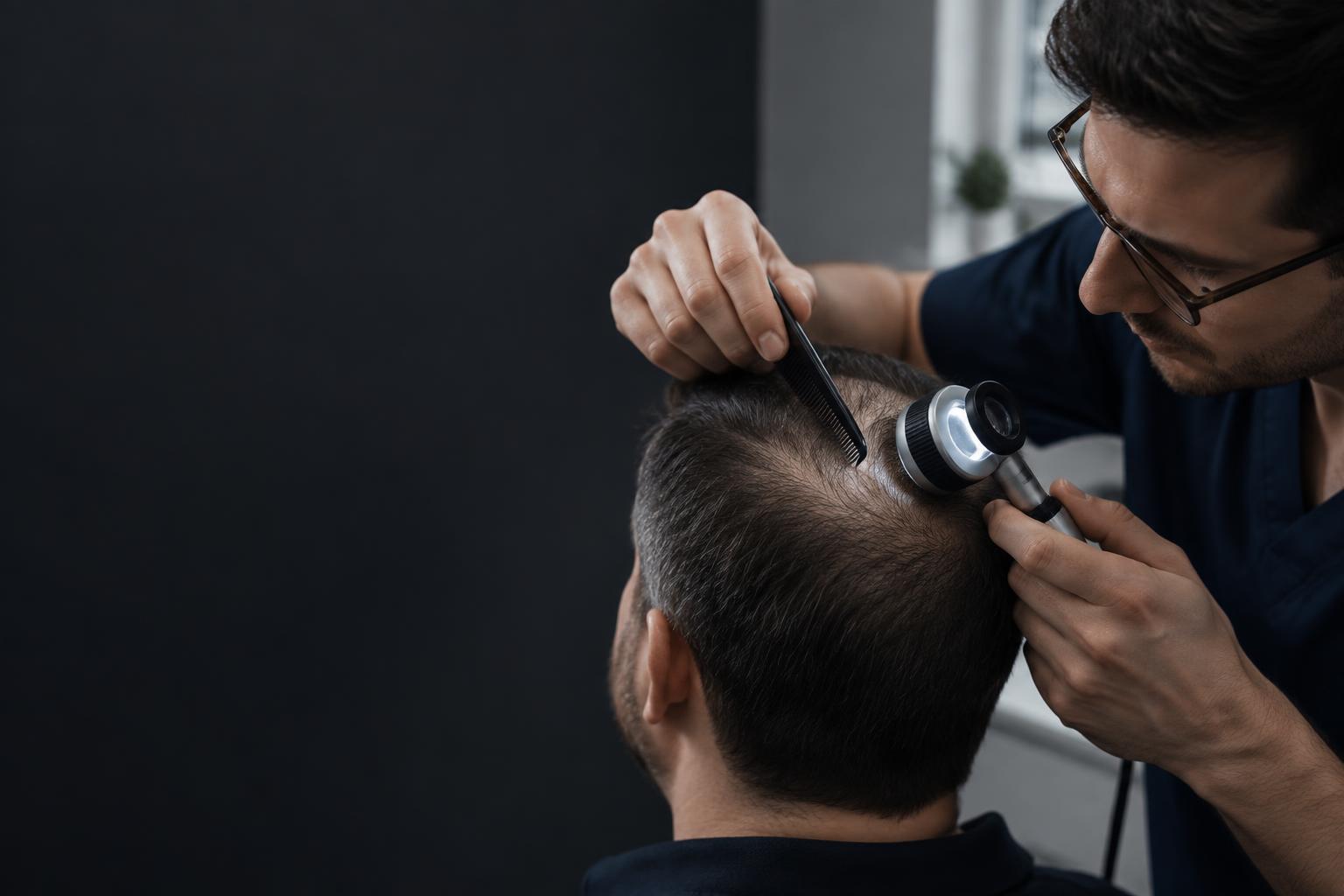
Trichoscopy and calibrated photography can count units and hairs within a known area. Baseline measurements should identify the scalp zone, hair length and miniaturisation. The same conditions are needed later to make a defensible comparison.
Before-and-after photographs are highly sensitive to flash, exposure, angle, wetness, comb direction, fibre products and hair length. BAHRS advises caution where conditions are not comparable. A dramatic photograph is not a density measurement. 3
Final assessment usually needs patience. Shafts often shed early, then grow and thicken unevenly. The NHS says the full result may take 12–18 months. 1 Ask when the clinic audits growth and how it handles an outcome below the agreed expectation.
- Same camera, distance and angle
- Same lighting and background
- Comparable hair length and styling
- Dry or wet state disclosed
- Named follow-up month
- Recipient and donor photographs
13 · Safety
When an impressive target becomes biologically expensive
Creating many closely spaced sites can increase bleeding and trauma and may compromise recipient blood supply, particularly in scarred or unhealthy tissue. Reported complications include poor growth, folliculitis, cysts, cobblestoning, ridging and rare necrosis. 9
Dense placement among miniaturised native hair can also contribute to shock loss. Even if temporary, it may make early appearance worse; vulnerable native follicles may not all recover. The surgeon should weigh reinforcement against replacing a zone likely to thin.
Donor harm is part of density risk. Achieving a high recipient number by excessive FUE can transfer the appearance of thinness from top to back. Consent should cover both sites and the possibility that a lower target or staged procedure is safer.
14 · UK standards
Density and graft numbers are clinical decisions
BAHRS cautions patients against allowing non-doctors to make definitive decisions on graft numbers, density or design. The operating doctor should diagnose, examine, explain options and take responsibility for the surgical plan. 3
All practising doctors should be GMC-registered and licensed. GMC guidance requires clinicians to work within competence, provide realistic information and obtain meaningful consent without pressure. 4 In England, the provider and premises should be CQC-registered. 5
Regulatory status does not certify aesthetic skill. Review relevant results, donor outcomes, training and complication arrangements. Ask whether the surgeon runs simultaneous cases and which steps are delegated.
15 · Reality check
Seven claims that lose meaning without context
Density language can sound scientific while leaving out the area, unit or survival. Translate every claim into measurable terms before comparing it.
| Claim | Evidence-led correction |
|---|---|
| More grafts always means denser | Area and survival determine density |
| 50 hairs equals 50 grafts | Units can contain multiple hairs |
| Native density can be restored | Finite supply prevents this over broad areas |
| One FU/cm² target suits everyone | Tissue and hair characteristics vary |
| Cost per graft predicts fullness | It says nothing about placement or growth |
| Photos prove density | Lighting and styling can transform appearance |
| A second session doubles the result | Supply and diminishing returns limit change |
16 · Take this list
Questions that turn ‘high density’ into a real plan
Begin with units and measurements. Ask for donor FU/cm² and hairs/cm² at multiple points, recipient area in cm² and intended placement by zone. If the clinic cannot connect the count to an area, its density claim is not testable.
Then ask how appearance is predicted. Hair calibre, curl, contrast, existing hair and direction should feature in the answer. Request matched photographs of patients with similar characteristics and equally clear donor views.
Finally, test the lifetime plan. How much reserve remains, what happens as native hair thins and who manages a lower-than-expected result? Take the written plan away and use the reflection period rather than accepting a same-day incentive.
- Which density are you quoting?
- What are my measured donor units and hairs/cm²?
- How many cm² does each recipient zone cover?
- What FU/cm² is planned in each zone?
- What hairs-per-graft mix is expected?
- How is growth measured and when?
- What donor density remains?
- Who creates the recipient sites?
- What is the plan for future loss?
17 · Decision
Density is biology, mathematics and design at once
Biology limits the supply and survival of follicles. Mathematics links graft number to area. Design turns those surviving hairs into coverage through allocation, angle and visual characteristics. Leaving out any one produces a misleading density promise.
The right target is not the highest figure a clinic advertises. It is a patient-specific plan that creates a worthwhile visual change, protects tissue and donor reserve, and can still make sense as hair loss progresses.
Ask for numbers—but ask what they measure. A trustworthy surgeon can explain where the estimate came from, where each graft will go and what uncertainty remains.
18 · Common questions
30 hair density FAQs
01What does hair transplant density mean?+
It can mean follicular units placed per cm², individual hairs per cm² or how full the result looks. Those are different measures. A useful plan states the unit, measured area and expected visual effect rather than saying only ‘high density’.
02What is FU/cm²?+
FU/cm² means follicular units per square centimetre. A follicular unit is a natural group containing one or more hairs. It is a placement or natural-density measure, not the same as hairs/cm².
03What is average natural hair density?+
Studies report different values by population, scalp site and method. One donor study found around 65–85 follicular units and 124–200 hairs per cm². These are descriptive ranges, not a target a transplant can simply recreate.
04Can a transplant restore full natural density?+
Usually not across a meaningful bald area. Donor supply is limited and recipient sites must preserve tissue blood supply. Surgeons use distribution, angle and hair characteristics to create an impression of fullness at lower numeric density.
05What density can a transplant achieve?+
There is no universal safe or cosmetic number. Figures around 20–35 FU/cm² are often discussed, but supporting evidence is limited and selected cases may be planned higher. Recipient health, graft size and survival alter the answer.
06Is a graft the same as a hair?+
No. A graft normally contains one natural follicular unit, which can hold one, two, three or occasionally more hairs. Two procedures with equal graft totals can therefore transplant different numbers of hairs.
07Does a higher graft count guarantee higher density?+
No. Count must be divided by the treated area, and final density also depends on survival. Expanding the hairline or adding the crown can spread the same grafts thinly. Graft composition and hair calibre also change appearance.
08What is dense packing?+
It means creating recipient sites close together to place a relatively high number of grafts per cm². The tissue and technique have patient-specific limits. Small studies disagree about survival at high densities, so no universal ceiling is established.
09Can grafts be packed too closely?+
Yes. Excessive site density may increase trauma, competition for blood supply and risks such as poor growth or tissue injury. The safe density depends on recipient condition, incision size, grafts, health and operator judgement.
10What is graft survival rate?+
It is the proportion of transplanted follicles or grafts judged to grow at a defined follow-up. Definitions and counting methods vary, so a percentage is meaningful only with its denominator, time point and measurement method.
11Why does hair calibre affect density?+
A thick shaft occupies and shadows more space than a fine shaft, producing more coverage at the same count. This is why an FU/cm² target cannot predict appearance without assessing the person's hair diameter.
12Does curly hair look denser?+
Curl and wave can increase overlap and apparent volume, often providing stronger coverage per shaft. Curl below the skin can also make FUE extraction more complex. Individual characteristics matter more than broad assumptions about ethnicity.
13Does hair colour affect density?+
Hair-to-scalp contrast affects how readily gaps are seen. Lower contrast can reduce scalp show-through, while dark straight hair against a light scalp may reveal spacing. Lighting, wetness and styling can greatly alter photographs.
14Why do two people with 2,000 grafts look different?+
Their treated areas, hairs per graft, calibre, curl, contrast, survival, hairline design and native hair differ. One may concentrate grafts at the front while another spreads them to the crown. Equal input counts do not equal identical outcomes.
15Should the hairline have maximum density?+
A natural hairline has a soft irregular transition, usually using single-hair units at the edge and greater visual mass behind. A hard, uniformly packed front can look artificial and consume supply needed for future loss.
16Why is the crown difficult to make dense?+
The crown can cover a broad circular area and its whorl sends hairs in multiple directions. It can require many grafts, continues to expand in some people and often receives lower priority than the face-framing frontal zone.
17What is donor density?+
It is the number of follicular units or hairs within a measured donor area. It helps estimate what can be removed while leaving coverage. Safe supply also depends on zone stability, calibre, scarring and future demand.
18Can donor density recover after FUE?+
No. Intact extracted follicles are moved permanently. Remaining hairs may cover the spaces and temporary shock shedding may recover, but the original follicular density is reduced for good.
19What happens if the donor is overharvested?+
The back and sides can look diffusely thin, patchy or moth-eaten, with visible pale dot scars. Repair options are limited because the resource needed to repair the area has already been depleted.
20Will native hair continue to thin after a transplant?+
It can. Transplantation does not switch off androgenetic hair loss in untreated native follicles. Apparent density can therefore change as surrounding hair miniaturises, making long-term design and appropriate medical discussion important.
21When can final density be judged?+
Early shedding and staggered regrowth make the first months unreliable. Growth and calibre develop gradually; the NHS says a full result may take 12–18 months. Standardised images at an appropriate follow-up are more useful than early impressions.
22How do professionals measure density?+
They may use trichoscopy, calibrated photography or phototrichograms to count hairs and units in a known area. Measurements should specify scalp zone and conditions. Visual coverage can also be graded systematically.
23Can I measure density from a phone photo?+
Not accurately without calibration, magnification and consistent conditions. A photograph can show scalp visibility but hair length, flash, angle, styling and wetness change appearance. It cannot reveal underground miniaturisation or safe donor boundaries.
24Can I trust before-and-after density photos?+
Treat them as useful only when angle, lighting, distance, hair length, styling and wetness match. Ask whether photographs show the named surgeon's patients and request donor views. Selected examples do not establish average performance.
25Who should plan transplant density?+
The doctor responsible for surgery should diagnose the loss, assess donor supply and agree design and graft numbers. BAHRS cautions against non-doctors making definitive clinical decisions. Ask exactly who creates recipient incisions.
26Do English clinics need CQC registration?+
Yes, providers and premises performing hair transplant surgery should be registered with the CQC. Check the exact location. Other UK nations have their own regulators.
27Is density different in FUE and FUT?+
Recipient density can be planned similarly because both methods ultimately produce follicular-unit grafts. Their donor harvest and scar patterns differ. Graft quality, supply and the clinician's placement strategy matter more than the acronym alone.
28Will a second transplant double density?+
Not necessarily. Remaining donor supply is smaller, placing between existing grafts can be more complex and visual gains show diminishing returns. A second session might extend coverage, strengthen one zone or address progression instead.
29What density questions should I ask a clinic?+
Ask for donor FU/cm² and hairs/cm², recipient area by zone, intended FU/cm², hairs-per-graft assumptions, survival measurement, clinician roles, reserve after surgery, photographs under matched conditions and the plan for future loss.
30Is guaranteed high density a red flag?+
Yes. ‘High density’ has no standard numeric definition and survival is biologically variable. A trustworthy clinician gives a range, explains trade-offs and makes the final plan conditional on donor and recipient findings rather than guaranteeing an adjective.
Keep reading
Related guides
19 · Sources
References and evidence notes
Sources were accessed on 6 October 2026. This guide distinguishes professional guidance and peer-reviewed evidence from illustrative claims. Evidence cannot predict an individual result.
- 1NHS: Hair transplant
UK patient guidance on suitability, procedure, recovery, risks, costs and checks.
- 2BAPRAS: Hair transplant surgery
Professional-body explanation of follicular units, FUE, FUT and surgical planning.
- 3BAHRS: Patient advice
UK specialist guidance on surgical roles, clinic checks and misleading claims.
- 4General Medical Council: Cosmetic interventions
Standards for competence, consent, reflection time and responsible marketing.
- 5Care Quality Commission: Surgical procedures: scope of registration
Registration requirements for surgical providers in England.
- 6ISHRS: FUE clinical practice guidelines
Specialist guidance on donor assessment, harvesting, handling and implantation.
- 7StatPearls: Hair transplantation
Peer-reviewed clinical overview of anatomy, candidacy, technique and complications.
- 8Parsley & Perez-Meza: Factors affecting growth and survival of follicular grafts
Peer-reviewed review of handling, hydration, temperature and out-of-body time.
- 9Aesthetic Plastic Surgery: Complications following hair transplantation
2025 systematic review and meta-analysis of reported complications.
- 10BAPRAS, BAAPS, BAHRS & TSPRAS: Minimum guidelines for hair transplant surgery
Joint guidance on doctor-led planning, consent and surgical responsibilities.
- 11ISHRS: Questions to ask your hair doctor
Patient guidance on scars, clinician identity, experience and outcomes.
- 12ISHRS: Top five things to know about hair transplantation
Specialist explanation of finite donor supply and realistic expectations.
- 13Jiménez & Ruifernández: Distribution of human hair in follicular units
Peer-reviewed donor-density study and mathematical model.
- 14Han et al.: Comparative evaluation of hair density and grouped hair units
Peer-reviewed phototrichogram study illustrating native-density variation.
- 15ISHRS: Hair characteristics: a major consideration
Professional educational review of calibre, curl and colour contrast.
- 16Keene, Rassman & Harris: Determining safe excision limits in FUE
Professional-journal discussion of finite donor supply and overharvesting.
- 17Lee et al.: Survival rate according to grafted density
Small technique-specific study; useful but not a universal density threshold.
- 18Van Neste et al.: Scalp Coverage Scoring
Structured method connecting visual scalp coverage with measured hair characteristics.