
01 · Answer first
No, every hair transplant does not require a fully shaved head
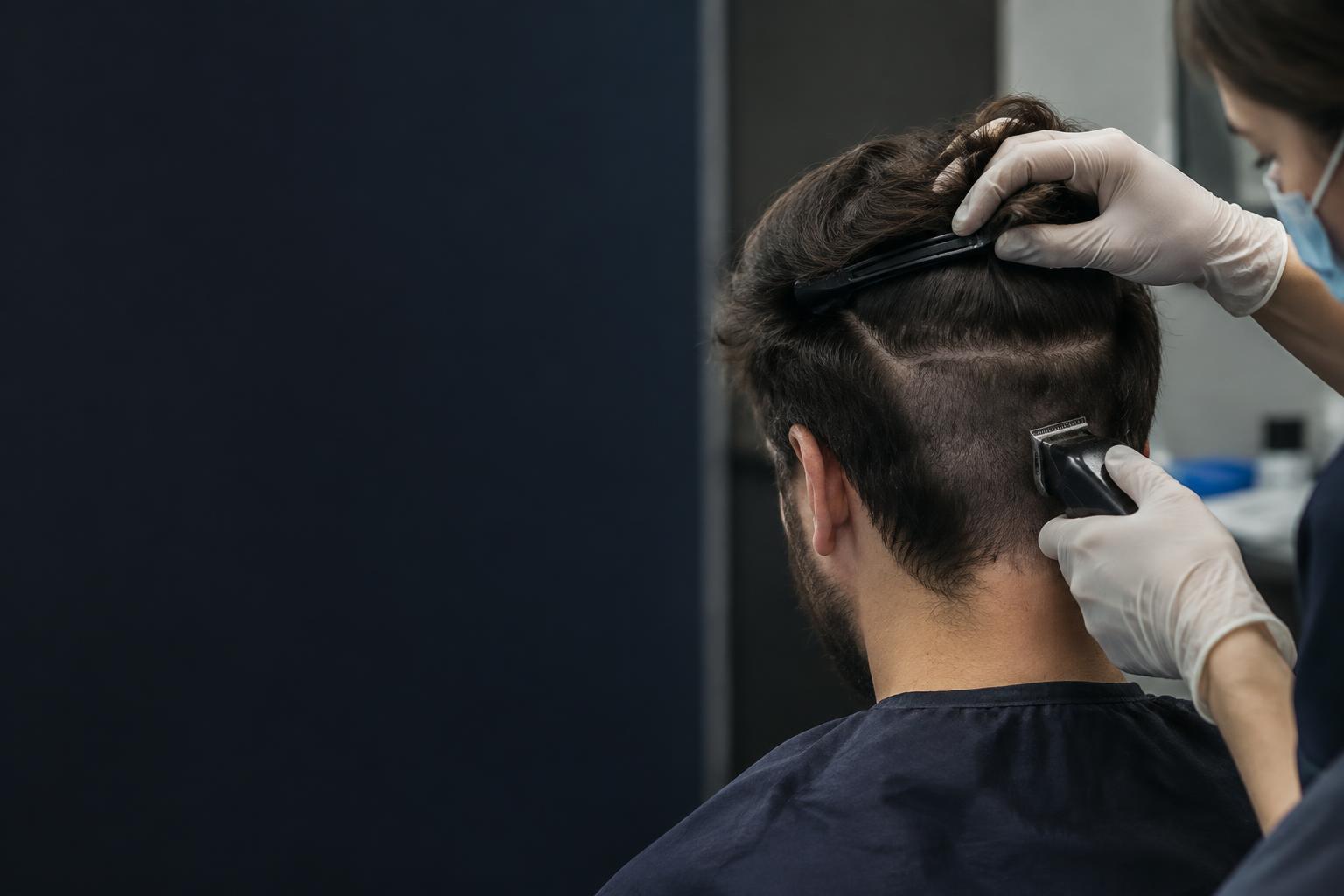
A full head shave is common for larger FUE procedures because short hair makes follicular units easier to see, space and extract. It is not a universal medical requirement. Some patients have only the donor area clipped, a concealed strip shaved beneath longer hair, or selected grafts harvested without shaving. 2 5
FUT usually does not require the whole scalp to be shaved. The surgeon removes a narrow strip from the donor region, and surrounding longer hair can often cover the closure. The recipient area may still be trimmed depending on the plan.
The right option is the one that lets the team perform accurately without compromising graft handling, donor management or implantation. A promise of ‘no shave’ should never replace a proper examination.
02 · Surgical access
Why shaving can make FUE easier and safer
In FUE, the team identifies follicular-unit direction, scores around each unit with a small punch and extracts it. Short hair improves visibility, reduces loose hair around the working area and makes it easier to distribute extractions evenly. 6 7
A larger session usually involves more donor sites and more recipient sites. Full or broad clipping can shorten operating time and help the team photograph, clean and inspect the scalp. That does not mean every patient needs the same haircut.
Shaving is an operational choice as well as a clinical one. Different experienced teams may use different protocols for a similar case, so ask for the practical reason behind the recommendation.
- Better view of hair direction and donor spacing
- Easier access for cleaning and extraction
- Clearer postoperative checks and photography
- Less interference from long hair during implantation
03 · Your choices
Full shave, partial shave and unshaven options compared
A full shave generally means the donor and recipient areas are clipped very short. A partial shave may leave the top longer while clipping a donor band that surrounding hair can conceal. Unshaven FUE means selected long hairs are trimmed individually or extracted at length using a specialised workflow.
‘No-shave FUE’, ‘long-hair FUE’ and ‘partial-shave FUE’ are not consistently defined. Ask exactly how many square centimetres will be clipped and whether the recipient area will also be shortened.
Smaller procedures are often easier to complete with limited clipping. With a large graft requirement, preserving every surrounding hair can make the operation longer and more technically demanding.
04 · FUE and FUT
How the transplant method changes the answer
FUE normally requires at least some donor trimming, although concealed and unshaven variants exist. FUT can preserve more visible hair because the strip is taken from within the donor region and the adjacent hair may cover the linear closure. 2 7
The implantation method does not automatically decide whether the recipient area needs shaving. Hairline refinements may be placed between existing hairs without a full recipient shave, while broad thinning may require more access.
Technique should be chosen around diagnosis, donor supply, scar preferences and long-term planning—not around avoiding a temporary haircut alone.
05 · Suitability
Who may be considered for limited-shave surgery
Patients with longer hair, a smaller graft requirement and sufficient donor density may be easier candidates for concealed donor shaving. Women and people who cannot visibly change their hairstyle for work often ask about this option.
Diffuse thinning can make implantation between existing hairs more demanding and raises the importance of diagnosis. Surgery is not automatically appropriate simply because it can be performed without shaving.
Only an examining clinician can judge whether limited access would affect extraction quality, operating time or the planned graft number.
- A modest, clearly defined treatment area
- Long enough donor hair to conceal a clipped strip
- Realistic expectations about temporary visibility
- A surgeon experienced in the specific technique
06 · Compare carefully
The practical disadvantages of avoiding a shave
Unshaven work may take longer, cost more and restrict the number of grafts a team is comfortable moving in one session. Long hair can obscure angles and may need careful handling throughout the procedure.
There can still be redness, crusting and visible recipient sites. Keeping hair long does not make the operation invisible, and swelling may remain noticeable for several days.
Do not assume a higher price or branded technique means a better result. Surgeon involvement, diagnosis, donor planning and aftercare remain more important than the haircut.
07 · Procedure day
What happens to your hair on the day
The team should confirm the design, donor boundaries, graft target and shaving plan before medication or surgery begins. You should have time to ask questions and consent to any change. 3 4
Hair is usually washed and the required zones are clipped after photographs and markings. Local anaesthetic is then used before harvesting and implantation.
Never shave the donor area yourself unless the clinic specifically instructs you. The team may need to assess density, hair direction and coverage while your hair is at its normal length.
08 · Appearance
How quickly will the shaved area look normal?
Hair grows at different rates, but scalp hair often becomes easier to blend over several weeks. A concealed donor strip may be hidden immediately by longer surrounding hair, although redness or crusting can remain.
The NHS says transplanted hairs commonly fall out after a few weeks and new growth often begins later, with full results taking 12 to 18 months. The haircut grows back much sooner than the transplant matures. 1
Follow the clinic’s washing and activity instructions. Do not use fibres, dyes, clippers or styling products over healing skin until the team says it is safe.
09 · Before deciding
Questions to ask about shaving
A good consultation should give a precise answer rather than a sales phrase. Ask who performs each surgical step and whether the clinic is registered for the procedure where required. 3 9
Request examples of patients with a similar hair length, donor pattern and graft number—but remember photographs cannot predict your result.
If a clinic changes the shaving plan on the day, ask why and make sure you are comfortable before proceeding.
- Will the donor area, recipient area or both be clipped?
- How large will the shaved zone be?
- Would avoiding a shave reduce the safe graft number?
- Does the option change the price or operating time?
- When can I wash, cut, colour and style my hair?
10 · Decision
Choose the plan, not the marketing label
You may not need to shave your whole head, but almost every surgical approach needs clear access to at least part of the scalp. The balance is discretion versus technical access.
Prioritise a sound diagnosis, an achievable graft plan and clear surgeon accountability. If two reputable surgeons recommend different clipping approaches, compare their reasoning rather than the label.
No online guide can decide suitability. A clinician must examine your scalp, donor density, hair calibre and pattern of loss before recommending an approach.
11 · Common questions
30 hair transplant shaving FAQs
01Do all FUE transplants require shaving?+
The answer depends on the technique, treatment area, graft number, hair length and clinic workflow. A clinician should confirm exactly what will be clipped before surgery.
02Can FUE be done without shaving?+
The answer depends on the technique, treatment area, graft number, hair length and clinic workflow. A clinician should confirm exactly what will be clipped before surgery.
03Does FUT require a shaved head?+
The answer depends on the technique, treatment area, graft number, hair length and clinic workflow. A clinician should confirm exactly what will be clipped before surgery.
04Can only the donor area be shaved?+
The answer depends on the technique, treatment area, graft number, hair length and clinic workflow. A clinician should confirm exactly what will be clipped before surgery.
05Can the shaved strip be hidden?+
The answer depends on the technique, treatment area, graft number, hair length and clinic workflow. A clinician should confirm exactly what will be clipped before surgery.
06Is unshaven FUE suitable for large sessions?+
The answer depends on the technique, treatment area, graft number, hair length and clinic workflow. A clinician should confirm exactly what will be clipped before surgery.
07Does no-shave FUE cost more?+
The answer depends on the technique, treatment area, graft number, hair length and clinic workflow. A clinician should confirm exactly what will be clipped before surgery.
08Does unshaven FUE take longer?+
The answer depends on the technique, treatment area, graft number, hair length and clinic workflow. A clinician should confirm exactly what will be clipped before surgery.
09Is no-shave FUE less effective?+
The answer depends on the technique, treatment area, graft number, hair length and clinic workflow. A clinician should confirm exactly what will be clipped before surgery.
10Will the recipient area be shaved?+
The answer depends on the technique, treatment area, graft number, hair length and clinic workflow. A clinician should confirm exactly what will be clipped before surgery.
11Can women have a hair transplant without shaving?+
The answer depends on the technique, treatment area, graft number, hair length and clinic workflow. A clinician should confirm exactly what will be clipped before surgery.
12Can long hair be transplanted?+
The answer depends on the technique, treatment area, graft number, hair length and clinic workflow. A clinician should confirm exactly what will be clipped before surgery.
13Should I shave my own head before surgery?+
The answer depends on the technique, treatment area, graft number, hair length and clinic workflow. A clinician should confirm exactly what will be clipped before surgery.
14How short is hair clipped for FUE?+
The answer depends on the technique, treatment area, graft number, hair length and clinic workflow. A clinician should confirm exactly what will be clipped before surgery.
15How quickly does donor hair grow back?+
The answer depends on the technique, treatment area, graft number, hair length and clinic workflow. A clinician should confirm exactly what will be clipped before surgery.
16Will people notice the shaved donor area?+
The answer depends on the technique, treatment area, graft number, hair length and clinic workflow. A clinician should confirm exactly what will be clipped before surgery.
17Does shaving damage follicles?+
The answer depends on the technique, treatment area, graft number, hair length and clinic workflow. A clinician should confirm exactly what will be clipped before surgery.
18Can I wear a hat after surgery?+
The answer depends on the technique, treatment area, graft number, hair length and clinic workflow. A clinician should confirm exactly what will be clipped before surgery.
19When can I use clippers after surgery?+
The answer depends on the technique, treatment area, graft number, hair length and clinic workflow. A clinician should confirm exactly what will be clipped before surgery.
20When can I colour my hair?+
The answer depends on the technique, treatment area, graft number, hair length and clinic workflow. A clinician should confirm exactly what will be clipped before surgery.
21Does shaving affect graft survival?+
The answer depends on the technique, treatment area, graft number, hair length and clinic workflow. A clinician should confirm exactly what will be clipped before surgery.
22Can afro-textured hair have limited shaving?+
The answer depends on the technique, treatment area, graft number, hair length and clinic workflow. A clinician should confirm exactly what will be clipped before surgery.
23Can a beard transplant be unshaven?+
The answer depends on the technique, treatment area, graft number, hair length and clinic workflow. A clinician should confirm exactly what will be clipped before surgery.
24What is partial-shave FUE?+
The answer depends on the technique, treatment area, graft number, hair length and clinic workflow. A clinician should confirm exactly what will be clipped before surgery.
25What is long-hair FUE?+
The answer depends on the technique, treatment area, graft number, hair length and clinic workflow. A clinician should confirm exactly what will be clipped before surgery.
26Why do clinics prefer a full shave?+
The answer depends on the technique, treatment area, graft number, hair length and clinic workflow. A clinician should confirm exactly what will be clipped before surgery.
27Can I change my mind on surgery day?+
The answer depends on the technique, treatment area, graft number, hair length and clinic workflow. A clinician should confirm exactly what will be clipped before surgery.
28Will no-shave surgery reduce graft numbers?+
The answer depends on the technique, treatment area, graft number, hair length and clinic workflow. A clinician should confirm exactly what will be clipped before surgery.
29Which technique is most discreet?+
The answer depends on the technique, treatment area, graft number, hair length and clinic workflow. A clinician should confirm exactly what will be clipped before surgery.
30What should my clinic confirm in writing?+
The answer depends on the technique, treatment area, graft number, hair length and clinic workflow. A clinician should confirm exactly what will be clipped before surgery.
Keep reading
Related guides
12 · Sources
References and evidence notes
Sources were accessed on 6 October 2026. This guide distinguishes professional guidance and peer-reviewed evidence from illustrative claims. Evidence cannot predict an individual result.
- 1NHS: Hair transplant
UK patient guidance on procedures, recovery, risks, costs and choosing a surgeon.
- 2BAPRAS: Hair transplant surgery
Professional guidance on FUE, FUT, recovery and realistic expectations.
- 3BAHRS: Patient advice
UK specialist advice on choosing a clinic, surgical roles and informed consent.
- 4GMC: Guidance for doctors who offer cosmetic interventions
Standards for consent, continuity of care and responsible cosmetic practice.
- 5ISHRS: Hair transplant procedures and patient information
Specialist educational material on surgical methods, growth and patient safety.
- 6StatPearls: Hair Transplantation
Clinical overview of indications, techniques, anaesthesia, complications and postoperative care.
- 7Journal of Cutaneous and Aesthetic Surgery: Hair transplantation: basic overview
Peer-reviewed overview of donor dominance, planning, harvesting and postoperative growth.
- 8NCBI: Complications in hair transplantation
Peer-reviewed review of complications, prevention and management.
- 9CQC: Choosing cosmetic surgery
England-specific advice on checking registration and asking providers questions.
- 10ISHRS: 2025 Practice Census Results
Survey data on contemporary procedure patterns and harvesting methods.